
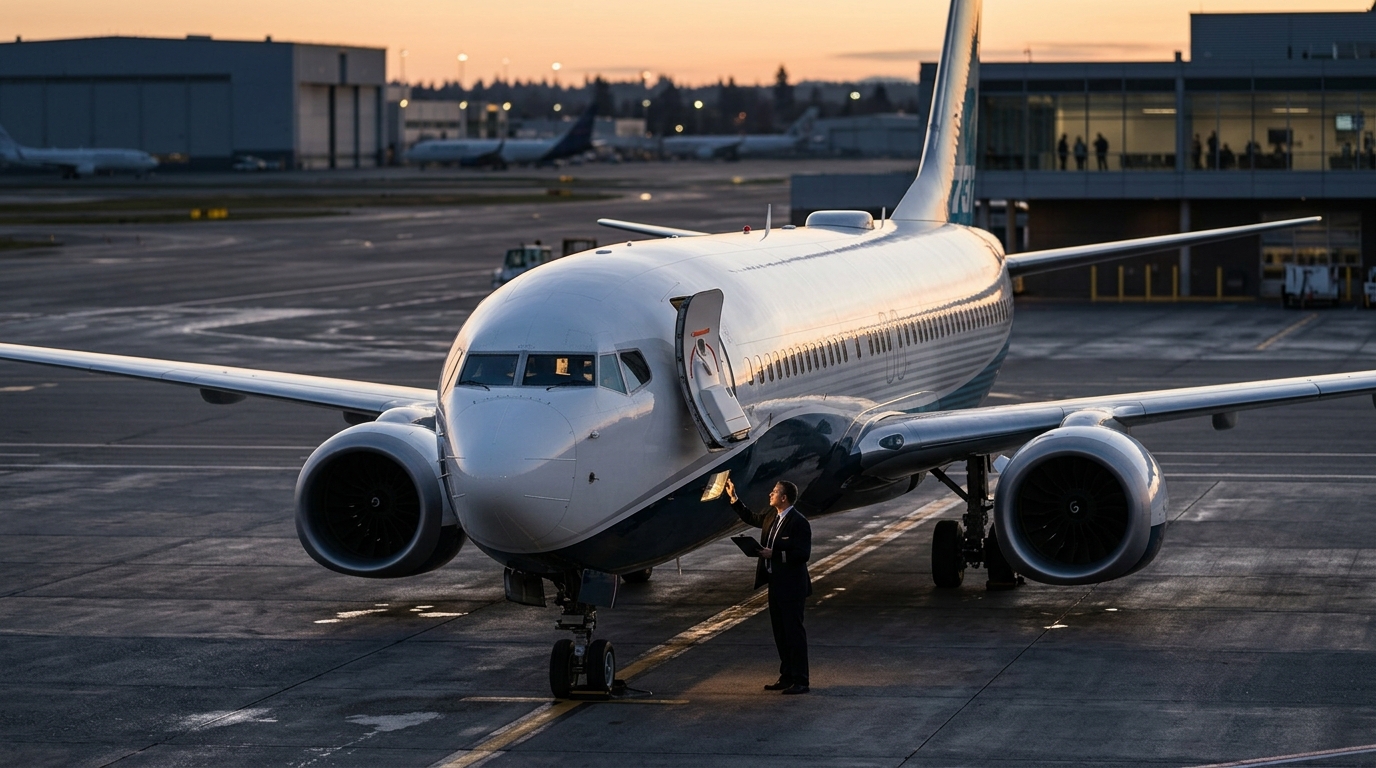
Thirteen days ago, Boeing CEO Kelly Ortberg stood before investors and said MAX 10 certification was coming “very soon.” On Monday, the FAA said not yet. The stock dropped nearly 7% on roughly 2.8 times normal volume, closing near $184, a price that sits within a few dollars of its 52-week low of $176.77. The question for investors is not whether this is painful. It obviously is. The question is what it actually costs Boeing in cash.
The answer starts with the software itself. The issue occurs following a missed approach, when a pilot alters the programmed flight path. At that point, the flight management computer may incorrectly transition from VNAV, the vertical navigation automation mode, to a more rudimentary pitch control setting. Boeing has said the issue can occur after a missed approach and go-around and that pilots are trained for those circumstances. The FAA has not yet said whether it views the behavior as a safety-of-flight issue, and the next step is the FAA’s internal review process to determine what must be addressed before the MAX 10 can be certified.
The timing is notable: the MAX 10 was reportedly days away from receiving FAA certification when the issue emerged. Ortberg said on September 16, 2026 that MAX 10 flight testing had been completed and that the program was in its final documentation phase with the FAA. The certification delay also raises questions about the MAX 7 timeline, even though the FAA has already certified the 737 MAX 7. Boeing has targeted first deliveries of both the MAX 7 and MAX 10 in 2027, so anything that slows paperwork, software updates, or delivery readiness still matters for 2027 cash flow even if it does not reopen the MAX 7 type certification itself.
The Cash Flow Problem
This is where the MAX 10 delay moves from an aviation news story to an investment problem. Management has reiterated guidance for $1 to $3 billion of free cash flow for 2026 and has described the long-term $10 billion free cash flow figure as “very attainable.” That longer-term ambition depended on key production and delivery milestones, and MAX 10 certification is part of that bridge: Boeing has said it continues to anticipate certification in 2026 and first delivery in 2027 for both the 737-7 and 737-10, so slippage that pushes certification meaningfully later than expected can push meaningful delivery-driven cash receipts to the right.
Boeing has a large order book for the 737-10 across major carriers. Those orders come with contractual delivery commitments and, critically, advance payments that Boeing does not fully recognize until aircraft are handed over. Customers can also have contractual remedies, including rights to reject deliveries if the delivery date is significantly later than the contractual date. Every month the certification clock runs, that remedy clause looks less theoretical.
The reporting around this issue has also highlighted a practical wrinkle: some airlines have sought clarity on which aircraft are affected and what software or operational mitigations apply, because delivery timing and aircraft acceptance can be sensitive to even temporary procedural or software workarounds. Until regulators and Boeing settle on the required corrective path, uncertainty can spill over into delivery scheduling even for aircraft that are already built.
Bull Case vs. Bear Case
The bull argument rests on two pillars. First, Boeing’s record backlog and a capacity-constrained Airbus keep BA trading in a range rather than freefall. There is no obvious place for airlines to divert large volumes of narrowbody orders on short notice. Second, Boeing has indicated it is working toward a permanent software fix, which could accelerate resolution if the FAA concludes the issue is manageable via a targeted change rather than a broader airworthiness concern that ripples through certification.
The bear case is straightforward: Boeing’s still-fragile cash profile means the equity story remains unusually dependent on execution and timing. A delay of Boeing’s $10 billion free cash flow run-rate ambition out by a year or two can materially shrink its present value, particularly with long rates elevated and investors less willing to wait for back-end cash generation.
What to Watch
The single most important variable is how quickly the FAA reaches a decision on what corrective actions, if any, must be completed before MAX 10 certification can be finalized. A conclusion that the VNAV behavior can be addressed with a contained fix could restore the certification timeline within weeks. A conclusion that demands more extensive software changes, testing, or documentation before any MAX 10 deliveries can begin would put the 2027 cash flow bridge in doubt.
At $184, Boeing is pricing in a fair amount of bad news. But the stock was at $202 just two weeks ago, before Ortberg flagged that MAX production stabilization was taking longer than planned. Two negative surprises in a fortnight is not a coincidence. It is a pattern, and until the FAA provides clarity, every delivery projection Boeing has offered should be held loosely.