
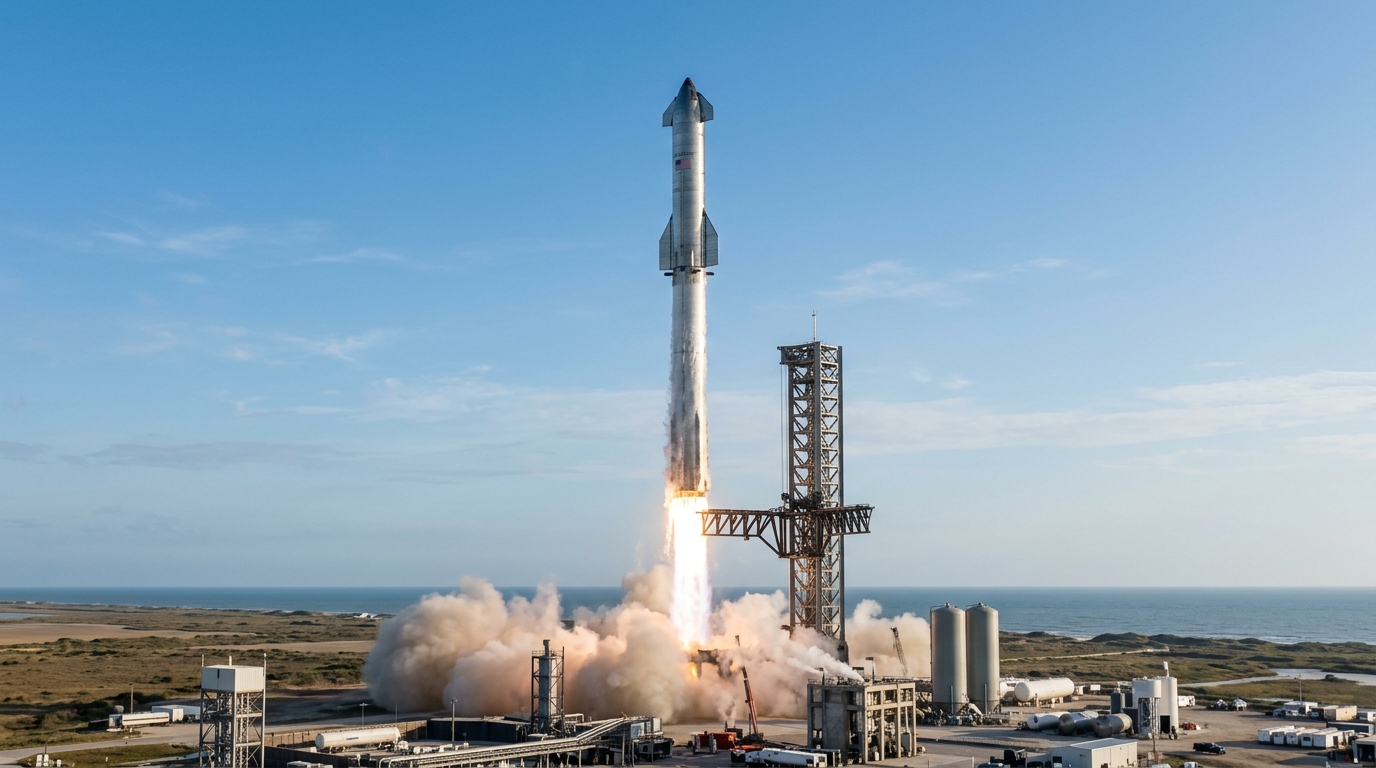
The window opens at 8:15 a.m. ET. SpaceX’s Starship Flight 14 is cleared for liftoff from Starbase, Texas, with a 75-minute opportunity that closes just before 9:30 a.m. The FAA issued the launch license late Saturday, clearing SpaceX to attempt the vehicle’s first orbital flight. Backup dates run September 29 and 30 if today slips.
Ship 41 will carry 26 Starlink V3 satellites, the first operational V3 units, and attempt roughly six orbits at approximately 275 km over a flight lasting just under 10 hours. Splashdown is targeted in the Pacific Ocean to the west of Chile, with the upper stage performing an orbital insertion maneuver, satellite deployment, and a deorbit burn using a single Raptor engine before reentry. It is also the program’s first revenue-generating mission.
Why This Matters for SPCX
SPCX closed Friday at $148.68, with its 52-week range spanning $104.83 to $225.64. That high was set on June 16, four days after the IPO began trading on June 12 at $150 following a $135 IPO price. The stock is now 34% off that peak and about 10% above its IPO price, which keeps the equity squarely in show-me territory.
Starship has flown twice since SpaceX began trading, and both attempts stayed suborbital. Reaching stable Earth orbit is the threshold at which the vehicle can begin flying revenue missions instead of ferrying test articles. Today changes that framing. If Ship 41’s orbital insertion burn succeeds, it will be the first time any Starship upper stage has completed a full orbit, and the first deployment of the V3 hardware that will eventually replace the current constellation.
The V3 capacity numbers are the commercial argument in clearest form. Each Starlink V3 satellite is designed to support about 1 Tbps of downlink capacity, for a total of about 26 Tbps on this mission alone, and the V3 stack is designed for Starship-class lift rather than Falcon 9. Repeatable Starship orbital flights, not one-offs, are what eventually justify the valuation.
Stocks in Focus
SPCX: Pre-market volume was already elevated Friday with 2 million shares changing hands before the open. Coverage heading into today centered on Starship execution and valuation risk, with analysts still seeing upside but several writers arguing the stock already prices in aggressive growth. The average 12-month price target sits at $222.42, with 28 analysts recommending a buy and only 2 suggesting selling. A clean orbital insertion and satellite deployment would likely close some of that gap to target. A booster failure or missed orbit keeps the debate open.
RKLB: Rocket Lab delivered stronger stock gains than SpaceX over the past week as several catalysts boosted the space sector. A Starship orbital success compresses the addressable market for medium-lift launch over time, and RKLB has historically pulled back when Starship milestones land cleanly. Watch whether RKLB holds the $63 area on a positive outcome.
ASTS: AST SpaceMobile’s direct-to-device business runs on constellation density. AST has discussed upgrades to Block 2 array technology, but investors still await firm shipment and launch timing for later Block 2 BlueBirds such as BlueBirds 14 through 16. A functioning Starship that can carry large payloads at scale eventually helps ASTS’s deployment economics, making today’s result a softer read-through rather than a direct binary event.
What to Watch
- Orbital insertion burn, roughly T+25 minutes: The orbital insertion burn will only proceed if flight controllers confirm sufficient hardware redundancy. This is the first decision gate that separates a nominal flight from a suborbital repeat.
- Satellite deployment: Confirmation that all 26 V3 units separated cleanly is the commercially meaningful signal. Partial deployment still leaves questions about V3 integration.
- Booster landing: Super Heavy Booster 21 is targeting a controlled splashdown in the Gulf of Mexico rather than a tower catch. Some recent booster attempts have ended before a soft touchdown. A clean splashdown reduces hardware cost concerns heading into the next flight.
The Cheat Sheet
Top Theme: Starship crosses from test program to revenue vehicle, or it doesn’t. The answer comes before the NYSE open.
Stock to Watch: SPCX. The orbital result is the most direct near-term catalyst for a stock sitting 34% off its high with a $222 consensus target.
Sector to Watch: Space and satellite. Clean orbital insertion lifts sentiment across RKLB, ASTS, and adjacent names.
Biggest Risk: Another suborbital outcome, which extends the commercial timeline and tests investor patience with a stock that has spent most of its public life below its first-day close.
One Thing to Remember: Starship must reach orbit for SpaceX to execute NASA’s Artemis lunar landing plan on the current schedule. That contract dependency means today’s flight carries consequences well beyond this morning’s pre-market move.