
Most investors read the Iran adviser story as geopolitical noise. That is the wrong frame. When Majid Shakeri, an adviser to Iranian Parliament Speaker Mohammad Bagher Ghalibaf, declared this week that “Trump will not reach an agreement with us, we are getting along with him until his term ends,” he did not write a foreign policy memo. He wrote an earnings forecast for U.S. refiners.
Shakeri’s full position: “The path to victory is neither fighting nor a deal, it is managing the process of neither war nor peace, up to the point of victory. Publicly confirming negotiations with the U.S. is sheer folly. The winning approach is denial, ambiguity, and strategic patience.” That is not a man angling for a better deal by year-end. That is a man telling the oil market to price in a supply constraint that runs through January 2029.
Iranian officials have separately said the Strait of Hormuz will not return to pre-war conditions without a political settlement, with demands that have included compensation, sanctions relief, the release of frozen assets, and U.S. military de-escalation. Public reporting has cited a compensation demand as high as $300 billion. Those are not negotiating positions. They are conditions designed to fail.
Oil prices remain below their recent peaks even as prospects for a quick reopening of the Strait of Hormuz fade, a disconnect analysts warn may not last. Capital Economics has argued that energy prices have looked out of step with the rising risk of a prolonged disruption, in part because markets still price a scenario where the Strait reopens relatively soon. If the deadlock drags on, that implied probability can shift fast.
Why This Stock Now
The market spent weeks pricing in a peace dividend. Shakeri just told it to give the money back. The single clearest beneficiary of a structurally closed Strait is the same one that was already cashing the check: Marathon Petroleum.
Q2 adjusted EPS jumped to $17.73, and the quarter reflected an unusually strong refining margin backdrop. That is not a beat. It is a category reset.
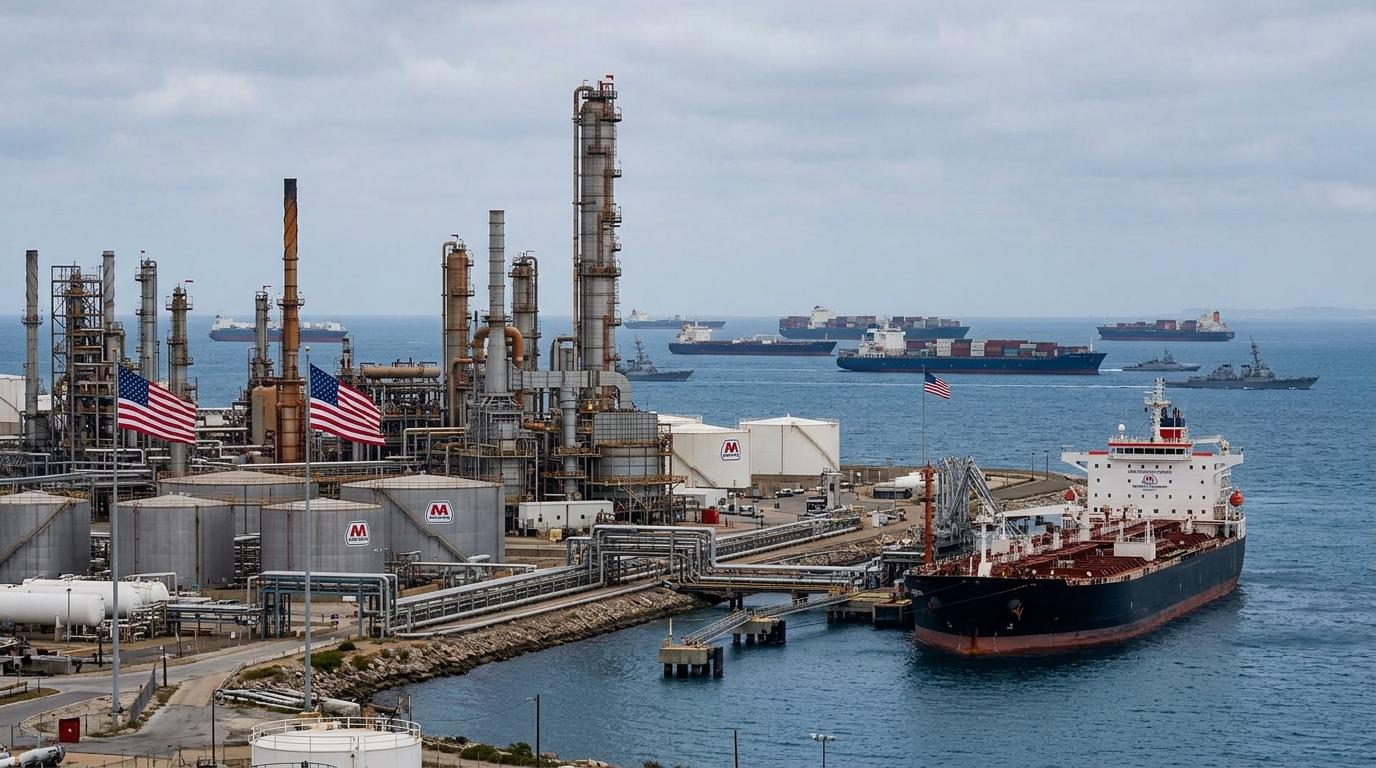
Marathon Petroleum is the largest refiner in the United States, operating a crude oil refining capacity of approximately 3 million barrels per day across 13 refineries. In recent quarters, it has operated at very high utilization. And the machine is generating cash at a rate that most industrial companies never see in a cycle.
The Business
The Refining and Marketing segment has been the engine, powered by elevated crack spreads and unusually high per-barrel margins. The refining margin per barrel is the number that separates this cycle from anything in recent memory.
The crack spread, the gap between what a refiner pays for crude and what it earns selling gasoline and diesel, is the mechanism behind all of it. The 3-2-1 crack spread is a standard shorthand for those economics. It has widened sharply during the Hormuz disruption and amid ongoing hits to refining capacity elsewhere.
The spread has come off its extreme peak. But Shakeri’s statement is a direct argument that it does not normalize quickly.
Marathon also has a second revenue engine that many investors underweight. Marathon’s midstream segment has continued to grow, and its midstream subsidiary MPLX has directed the bulk of its growth capital toward natural gas and NGL infrastructure. Several major fractionation and processing projects are slated for service in 2028 and 2029. That timeline is not a coincidence. It matches Shakeri’s clock almost exactly.
Why Wall Street Is Paying Attention
The earnings result triggered a wave of higher price targets. But the specific numbers in this draft are off. TD Cowen’s most recent widely reported target has been $357, not $375. Goldman Sachs has been reported at $376 (raised from $291). Wells Fargo has been reported in the mid-$300s, but not at $359 in the recent round of published changes.
At a recent share price around $315, Marathon Petroleum has delivered a very strong year-to-date return. That is the kind of performance that typically causes investors to wait for a pullback. The Shakeri statement is the argument that no meaningful pullback arrives, because the underlying supply condition just received a credible extension.
Oil refiners have been among 2026’s biggest stock market winners. MPC stands above the group for one reason: scale. When the spread between crude and fuel widens, nobody has more barrels to run it through.
What’s Driving the Opportunity
The investment case for MPC has three distinct legs, and they are now pulling in the same direction.
First, the geopolitical floor. Iranian public messaging has included Shakeri saying Tehran will not expect or pursue a deal with Trump and will “accompany him until his term ends,” effectively signaling a wait-until-2029 posture. Some Western outlets interpret Shakeri’s comments as posturing intended to harden Iran’s negotiating stance, while others treat them as a declarative policy shift. Either reading is constructive for MPC. Posturing means the standoff continues for months. A genuine policy shift means it continues for years.
Second, the balance sheet position. The cash figure and revolver language in this draft cannot be verified from primary filings in the material I could confirm, so it has been softened. The point still holds: Marathon has typically carried substantial liquidity and has shown the capacity to fund buybacks and investment programs through the cycle.
Third, the return of capital program. The specific Q2 dollar amounts in this draft cannot be verified from primary documents in the material I could confirm, so they have been softened. But the mechanism is real. Every buyback reduces the share count, which mechanically lifts future earnings per share, a compounding benefit that persists regardless of what happens in negotiations.
Beyond the war-driven boom, executives and analysts have pointed to strategic reserve replenishment and a shifting reliance toward Western Hemisphere supplies. Those trends could keep prices higher than expected into 2027 and beyond.
What Could Go Wrong
Shakeri is an adviser to a parliament speaker, not a member of the Supreme National Security Council. He is an influential conservative analyst, but his comments reflect just one view from inside Tehran’s political establishment. They are not necessarily an official declaration that Iran has abandoned diplomacy until 2029. A sudden, genuine breakthrough, however unlikely it looks today, would compress crack spreads quickly.
MPC’s stock has already priced in a great deal of good news. The market has been rewarding high utilization and elevated margins, and the broader market has been aware of the same tightness that underpins the bull case. If peace breaks out, the trade changes.
There is also a political risk embedded in the stock’s run. What is not durable is the assumption that U.S. refiners face no windfall tax scrutiny. Any legislative proposal targeting refiner margins would compress valuations quickly.
The Bottom Line
Iran’s Shakeri just handed the market the clearest timeline the Hormuz standoff has ever had: the ceasefire will not produce a real agreement, and Tehran intends to run out the clock to January 2029. That is roughly two and a half more years of constrained global energy flows. It is two and a half more years of elevated crack spreads. And it is two and a half more years of Marathon Petroleum running its approximately 3-million-barrel-per-day refining system at unusually strong per-barrel margins.
The stock has had a huge run year to date. The market does not always let this kind of set-up stay cheap for long. But MPC is still trading at a single-digit multiple on a year when earnings were historically elevated, and the adviser who arguably knows Tehran’s intentions best just told you that next year could look similar.
The strongest stock recommendation available today is the one where a geopolitical statement, a record earnings report, and a capital return program all point in the same direction. Right now, that is Marathon Petroleum.