
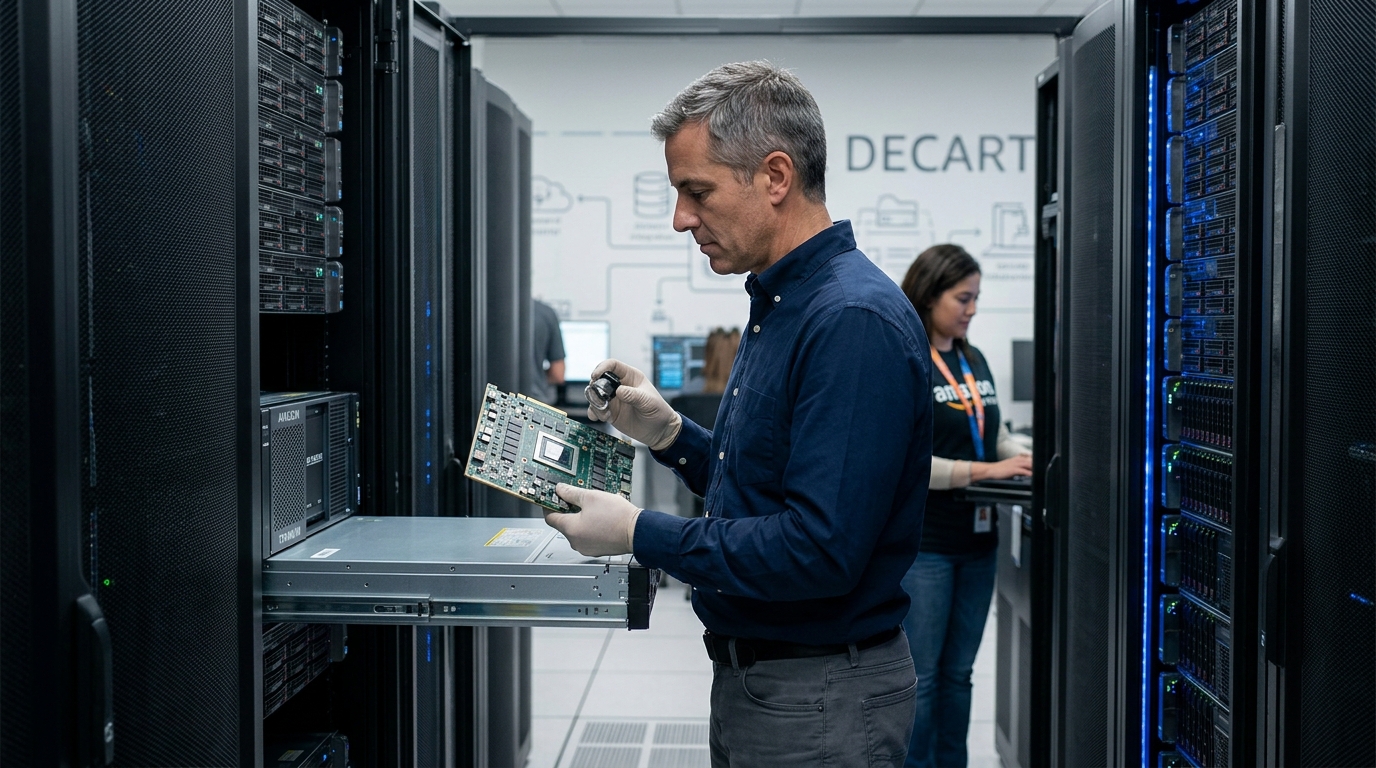
Here is the question Amazon cannot answer with a press release: why would a developer building an AI application choose an Amazon Trainium chip over an Nvidia GPU, when Nvidia’s ecosystem is larger, more familiar, and has years more tooling behind it? Decart is Amazon’s reported $7 billion answer.
Decart has built software that makes it easier for developers to run AI models on different processors, and according to the Wall Street Journal, Amazon is in talks to acquire the company, with a deal that could be wrapped up in coming days, assuming the talks don’t break down or another suitor doesn’t emerge. The startup, founded in Israel in 2023, sits at the exact intersection Amazon needs: it solves the most stubborn friction point in AWS’s chip ambitions.
The Decart Optimization Stack, or DOS, is an inference and training platform the company says runs across Nvidia GPUs, Google TPUs, and Amazon Trainium, delivering more than 1,600 tokens per second for agentic inference. For any developer tempted to try Trainium but worried about migration pain, that software is the on-ramp AWS has struggled to build alone.
The proof of concept was already public. In December 2025, Decart announced a collaboration with AWS to optimize its Lucy model for Amazon’s Trainium3 chips, obtaining early access and reporting outputs up to 100 frames per second at about half the cost of GPUs. Amazon and Decart have also pointed to high hardware utilization in that work, including claims of more than 80% Model FLOPS Utilization on Trainium. That kind of validated efficiency is a sales tool, not just a benchmark.
In his 2025 shareholder letter, CEO Andy Jassy wrote that Amazon expected approximately $200 billion in capital expenditures in 2026. Spending that much on chips and data centers only compounds into returns if customers actually run workloads on Amazon silicon. Without software that makes Trainium easy to adopt, the capex is infrastructure without a market.
Decart’s second product line adds another dimension. Lucy 2.5 edits live video at 1080p and 30 frames per second as of July 2026. Lucy generates and edits video in real time, with applications across advertising, commerce, streaming and gaming, while Oasis creates interactive environments for robotics and autonomous systems. Both are compute-hungry. If they become standard AWS services, they pull Trainium demand with them.
If the deal materializes, it would surpass Amazon’s MGM deal, which it announced in 2021 as an $8.45 billion acquisition. The reported $7 billion price also marks a sharp jump from Decart’s roughly $4 billion valuation in May 2026. Anthropic reportedly explored buying Decart for about $6 billion earlier in 2026, then walked away after due diligence. Amazon is bidding $1 billion above where a sophisticated AI buyer stopped. That gap needs a good explanation, and the Trainium strategic logic is it.
The bear case is straightforward. If Trainium and Decart’s tooling don’t deliver comparable performance or developer adoption, customers keep buying Nvidia at scale. Acquisition-driven developer ecosystems are notoriously hard to build, and Decart’s team will face integration pressure the moment the deal closes.
Decart raised $300 million at a roughly $4 billion valuation in May, with investors including Radical Ventures, Nvidia, Adobe Ventures, Sequoia Capital, and Benchmark. Nvidia’s presence on the cap table is an irony worth noting: the company whose dominance Amazon is trying to chip away at is also a financial backer of the startup Amazon wants to buy.
Watch two metrics once this deal closes: Trainium’s share of AWS compute revenue, and whether enterprise AI developers actually cite DOS as a reason for switching hardware. Those are the signals that will determine whether Amazon paid $7 billion for a chip strategy or an expensive experiment.