TITLE: Zebra Is Up 20% Today: The Supply Constraint Is the Real Story.
SUBTITLE: Record Q2 revenue, a 75.9% EPS surge, and a guidance raise that memory chips could still derail.
Demand is not Zebra’s problem. Supply is.
That one sentence captures what happened on August 4, 2026, when Zebra Technologies (NASDAQ: ZBRA) reported its best quarter in company history and the stock jumped roughly 20% in a single session. The headline numbers were genuinely impressive. But the more interesting investment question lives underneath them, in a supply chain battle that pits enterprise automation against AI data centers for the same scarce chips.
What the Quarter Actually Said
Revenue came in at $1.557 billion, a 20.4% year-over-year increase that beat the analyst consensus of roughly $1.50 billion by more than $50 million. Organic constant-currency growth ran at 9.2%, meaning the outperformance was not purely a function of acquisitions or currency tailwinds.
Profitability told an even sharper story. Adjusted EBITDA reached $431 million, up 61.4% year over year, with margins expanding 710 basis points to 27.7%. Non-GAAP diluted EPS surged 75.9% to $6.35, landing nearly $2.00 above Zebra’s own prior guidance range.
Both operating segments contributed. Connected Frontline revenue grew to $903 million from $717 million a year earlier. Asset Visibility and Automation climbed to $654 million from $576 million, with organic growth of 11.4% outpacing the broader business. The geographic picture was similarly broad: double-digit growth in retail, manufacturing, and healthcare across multiple regions.
The Memory Problem Nobody Is Talking About
Strip away the tariff-recovery benefit, and the result is still strong. Zebra recorded $73 million of IEEPA tariff recoveries, and the company said $14 million was received in the quarter. Even excluding that one-time item, the underlying profitability trend was still positive.
But the Q3 guide immediately tells you where the friction lives. Management guided Q3 revenue growth of 17% to 20% with non-GAAP EPS of $4.70 to $4.90 and adjusted EBITDA margin of approximately 22%, a step down from the 27.7% posted in Q2. The culprit is memory.
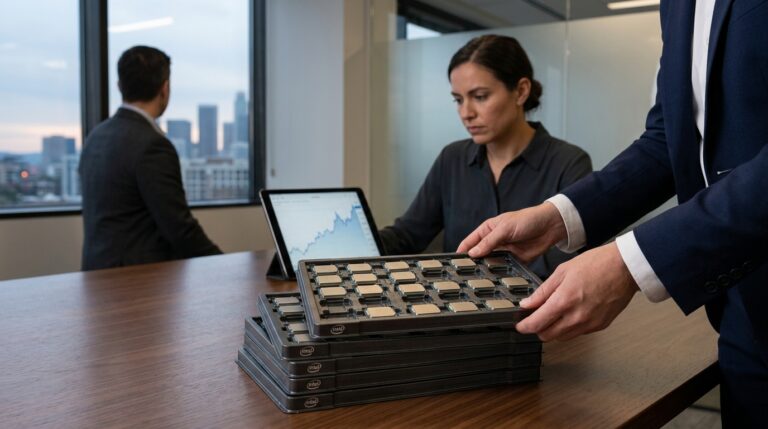
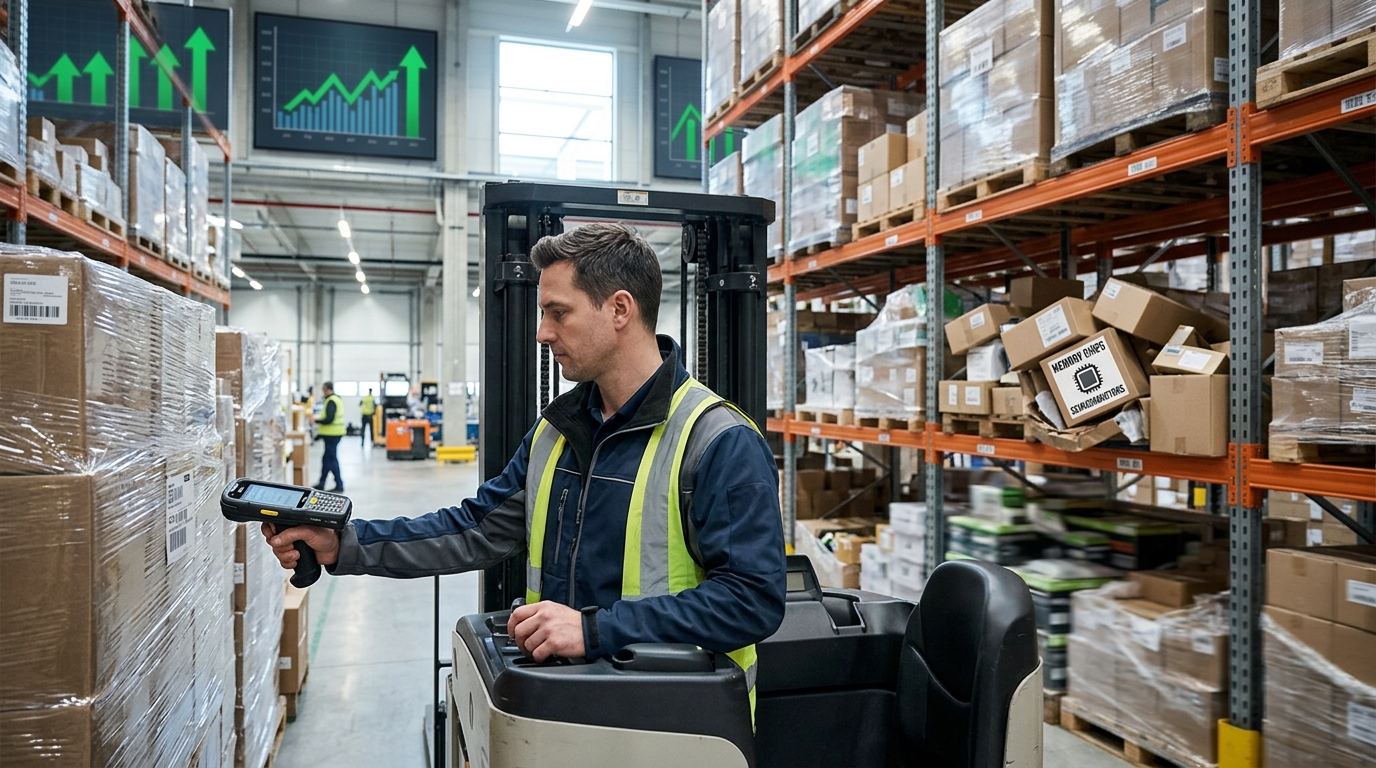
The global memory shortage, driven by AI data centers reallocating DRAM and NAND capacity toward high-bandwidth memory for accelerators, is compressing supply for enterprise hardware makers. Zebra is running directly into that wall. Memory costs are expected to run roughly $120 million higher for the full year, and management has said it is taking pricing actions to help offset the impact.
On the earnings call, CEO Bill Burns was direct: the high end of the sales guide is essentially unconstrained by demand. The low end reflects what happens if memory allocations tighten further. Zebra got more chips than expected in Q2, which is the primary reason results landed above the top of the prior guidance range.
The structural backdrop makes this more than a one-quarter issue. Manufacturing capacity is shifting toward higher-margin HBM products for AI infrastructure, and that conversion directly cuts the supply of general-purpose memory that Zebra’s handheld computers and scanners require. One analysis estimates elevated prices and tight supply could persist into late 2027 or 2028.
The Counterintuitive Customer Behavior
Here is what makes this situation genuinely unusual. Enterprise customers are not skimping on memory to manage costs. According to comments from the earnings call, the largest buyers are ordering extra memory capacity at higher prices, because they would rather over-buy today than discover in 2028 that their scanners cannot run the AI models they intend to deploy.
That behavior has two implications. First, Zebra’s near-term demand signal is not weakening. Second, the company’s ability to pass price increases through to customers appears intact, at least for now. Management has pointed to pricing actions aimed at offsetting memory cost inflation, a move that suggests the customer base is absorbing cost increases rather than deferring purchases.
This dynamic also connects to a broader product transition. In June, Zebra debuted the CV70 CXP high-performance machine vision camera at Automate 2026, targeting high-speed, high-resolution industrial applications including EV battery assembly and semiconductor inspection. A Zebra survey found 98% of manufacturing leaders plan to adopt machine vision technology by 2029. The company is positioning itself at the intersection of physical operations and AI inference, which requires more capable, memory-intensive hardware than prior generations.
Portfolio Sharpening Adds Strategic Clarity
Earlier this year, Zebra completed the sale of its Robotics Automation business to Skild AI in exchange for cash consideration and an equity stake in the acquirer. The move was explicit: sharpen focus on RFID, machine vision, and AI for frontline operations rather than managing a diversified robotics unit. That decision now looks well-timed. The segments Zebra kept are the ones growing fastest.
RFID came in roughly flat in Q2 due to project timing, but management maintained the expectation of full-year double-digit growth in that category. The opportunity set is expanding beyond retail apparel into broader merchandise, parcel, fresh food, and healthcare tracking, all of which carry recurring-revenue characteristics that hardware alone does not.
The Full-Year Math
Management raised the full-year 2026 outlook to revenue growth of 14% to 16%, adjusted EBITDA margin of 23.5% to 24%, and non-GAAP EPS of $20.75 to $21.25. That compares with the prior guidance of 10% to 14% revenue growth and EPS of $18.30 to $18.70. Free cash flow is now expected to exceed $1 billion for the year, implying roughly 100% conversion.
Capital returns have been aggressive. Zebra repurchased $568 million of stock in the first half of 2026 alone, and the company reported $268 million of share repurchases in Q2. At roughly 16.5 times the new full-year EPS guidance, the stock is not cheap by historical standards. But it is not pricing in a full reacceleration of the automation spending cycle either.
Where the Risks Actually Live
The memory constraint is the most tangible near-term risk. If chip allocations tighten further in Q3, Zebra’s ability to fulfill orders, not generate them, becomes the binding constraint on revenue. That is an unusual position for an enterprise hardware company and one that most valuation models are not built to handle cleanly.
The tariff recovery that flattered Q2 margins is also a one-time item. Zebra has recorded $73 million of IEEPA tariff recoveries, with only a portion received in cash during the quarter, and investors should watch how additional recoveries are realized and reflected across subsequent periods.
Finally, RFID’s flat Q2 result, even with project-timing explanations, is worth tracking. The category carries some of the most compelling long-term growth characteristics in Zebra’s portfolio. A sustained delay in RFID adoption across fresh food or healthcare verticals would affect the most defensible part of the long-term thesis.
The Bigger Picture
Zebra sits at an unusual intersection right now. Its customers are deploying AI at the operational edge, which means more capable, more memory-intensive devices. The same AI buildout is constraining the supply of the chips those devices require. That tension could resolve in Zebra’s favor as memory supply gradually normalizes, or it could cap revenue for several more quarters if the AI infrastructure buildout continues absorbing the majority of available DRAM capacity.
What the Q2 results confirmed is that demand for intelligent frontline operations is real and broad-based. Retail, manufacturing, healthcare, and logistics are all buying. The company is passing costs through. Free cash flow is accelerating. And the product roadmap, from machine vision to AI-native mobile compute, is aligned with where enterprise spending is heading over the next three to five years.
The memory constraint is not a demand problem. It may actually be the best kind of problem a company can have: the business would grow faster if supply allowed it. Whether that framing holds through the second half of 2026 is the question worth watching.
Final Thought
Zebra’s 20% single-day move reflects a market that had underestimated both the company’s pricing power and the stickiness of its customer relationships in a constrained environment. The full-year raise of roughly 13% at the EPS midpoint is significant by any measure. The stock’s next test is Q3, where the memory headwind is already acknowledged, the tariff tailwind is gone, and execution against a 22% EBITDA margin target becomes the proof point. That is a harder quarter to navigate than Q2, and investors should size positions accordingly.
Disclaimer: This editorial is for informational purposes only and does not constitute investment advice, a solicitation, or a recommendation to buy or sell any security. Investing involves risk, including the possible loss of principal. The information presented here reflects publicly available data and management commentary as of August 5, 2026. Past performance is not indicative of future results. Always conduct your own due diligence or consult a licensed financial advisor before making investment decisions.