
Hey there, bargain hunter.
The AI infrastructure trade has produced a lot of winners in 2026. CoreWeave (CRWV) is not one of them. The stock is sitting roughly 60% below its peak from mid-2025, has spent most of the summer below $100, and closed at $79.94 on July 14 — its lowest level in months. That’s a painful stretch for a company that Wall Street was practically fistfighting over just a year ago.
Here’s the thing though. The business hasn’t stopped growing. Not even close.
What the Numbers Actually Say
Q1 2026 was the strongest quarter in CoreWeave’s history, at least on the revenue side. Revenue came in at $2.08 billion, up 111.7% year over year. The company reaffirmed full-year 2026 revenue guidance of $12 billion to $13 billion, with an exit run-rate target of $18 billion to $19 billion. The backlog — the figure everyone obsesses over — surged 50% sequentially to $99.4 billion after the Meta deal landed.
That Meta deal is worth pausing on. In April, CoreWeave announced a $21 billion expanded AI infrastructure agreement with Meta Platforms to provide cloud capacity through December 2032. Then Jane Street showed up with a $6 billion cloud commitment plus a $1 billion equity investment at $109 per share. These are not small deals.
Wolfe Research, which maintains an Outperform rating with a $150 price target, estimates the Q2 backlog may land between $110 billion and $115 billion — and expects CoreWeave to exit 2026 with a backlog above $135 billion. That’s a number that should get your attention.
Why the Stock Is Still in Freefall
The bear case is legitimate and you shouldn’t skip it.
Debt has surged from $2 billion in 2023 to $25.1 billion as of March 31, 2026. Q1 free cash flow was negative $4.71 billion. Capital expenditure hit $7.70 billion in a single quarter, and interest expense doubled to $536 million. Total liabilities reached $50.81 billion against $4.76 billion in shareholders’ equity. On top of that, a securities fraud class action lawsuit alleges the company concealed data center construction delays and understated reliance on a single third-party supplier. And in early June, CEO Michael Intrator sold roughly $37.6 million in shares.
None of that is trivial. A stock does not fall 60% from its high on rumor alone.
What also hurt: on July 1, CoreWeave shares cratered roughly 14% in a single session after reports surfaced that Meta Platforms was considering expanding its own AI cloud offerings. The irony, of course, is that Meta just signed a $21 billion deal with CoreWeave three months earlier. Markets are not always rational — especially when the fear is big enough.
The Bull Case Rests on Scarcity
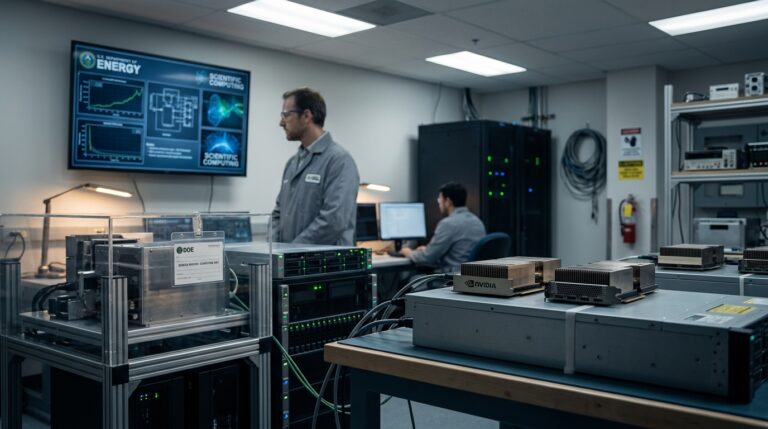
CoreWeave has surpassed 1 gigawatt of active power and has contracted more than 3.5 gigawatts, targeting 8 gigawatts by 2030. Backlog visibility went from $30.1 billion in Q2 2025 to $99.4 billion in Q1 2026 — that’s not a business in trouble, that’s a business running as fast as it can to meet demand that already exists. Nvidia has invested $2 billion in CoreWeave directly and named it the Exemplar Cloud for inference on the GB200 NVL72 system.
Cantor Fitzgerald carries a Buy rating with a $167 price target. The company’s own guidance implies it will exit 2026 with low double-digit adjusted operating margins.
The tension here is as clean as it gets in markets: a company with triple-digit revenue growth, a near-$100 billion contracted backlog, and Nvidia’s public stamp of approval — trading below the price Jane Street paid for equity four months ago.
August 18 Is the Date
CoreWeave is expected to report Q2 2026 results on August 18. That report will answer the questions nobody can currently resolve: Did the backlog keep growing? Did margins start recovering? Is the free cash flow trajectory improving, or getting worse?
Q2 guidance from management called for revenue of $2.45 billion to $2.60 billion and adjusted operating income of $30 million to $90 million. Those numbers, if hit, would represent continued sequential acceleration. The EPS line will almost certainly disappoint again — and the market will have to decide whether it cares more about that or the backlog.
One more thing that doesn’t get enough attention: CoreWeave is now in the Nasdaq-100. Index funds are structurally required to hold it. That creates a floor of mechanical demand that didn’t exist six months ago.
The Cheap Investor Scorecard
- Revenue growth (Q1 2026): +112% year over year
- Revenue backlog (Q1 2026): $99.4 billion, up 50% sequentially
- Full-year 2026 revenue guidance: $12 billion to $13 billion
- Q1 free cash flow: negative $4.71 billion
- Total debt (as of March 31, 2026): $25.1 billion
- Q1 capex: $7.70 billion
- Active power capacity: over 1 gigawatt, targeting 8 GW by 2030
- Nvidia investment: $2 billion Class A stake
- Meta agreement: $21 billion through December 2032
- Q2 earnings date: August 18, 2026
The stock is not cheap by conventional measures. But the backlog is unlike anything in cloud infrastructure history, the customers are real, and the selloff has been severe enough to make the risk-reward worth a hard look. If Q2 shows backlog holding above $110 billion and margins starting to recover, the gap between the business and the stock gets very hard to justify. If free cash flow deteriorates further and the legal situation escalates, the bear case wins. That’s the trade.