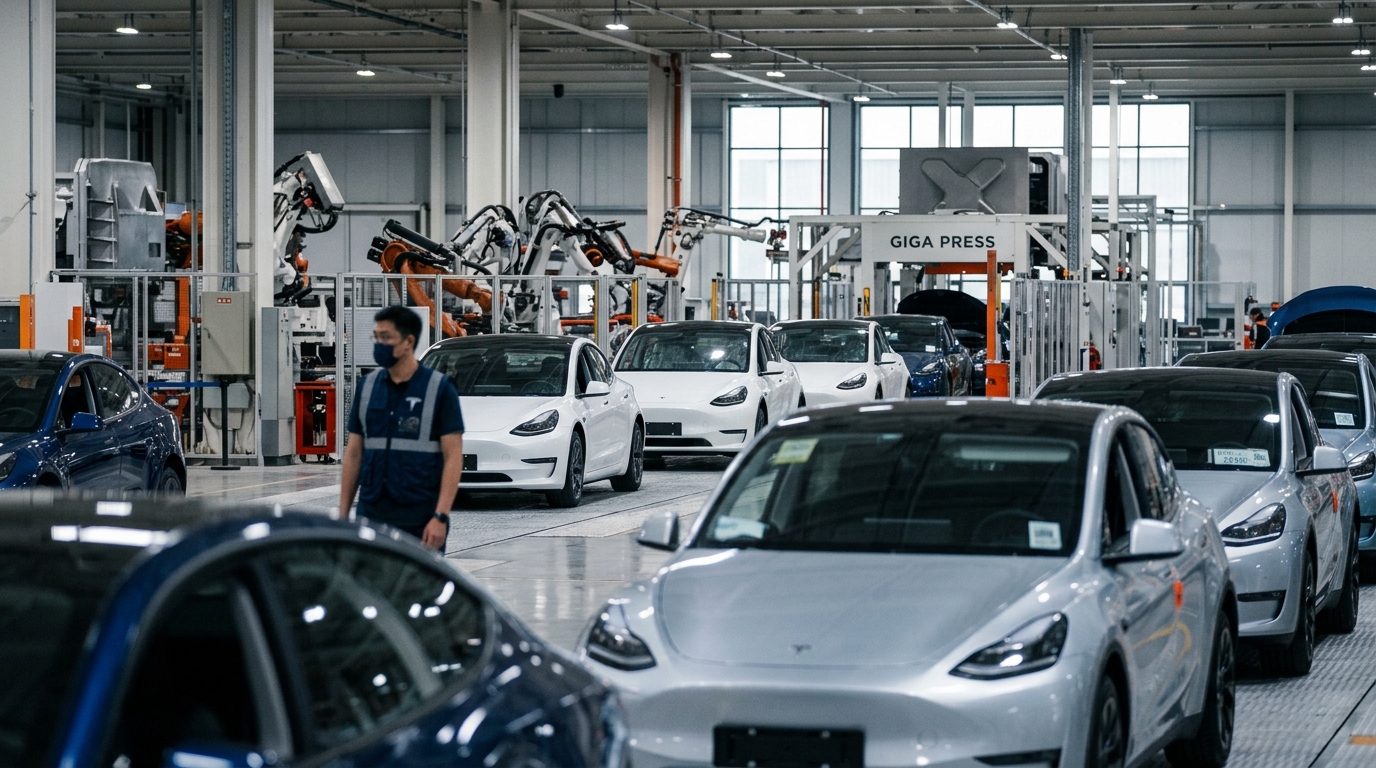
Here’s the thing about Tesla right now. The number everyone was watching — deliveries — already landed. 480,126 vehicles in Q2, well ahead of the ~406,600 Wall Street had modeled. Up 25% year over year. Up 34% sequentially. By most measures, that’s a genuine beat.
The stock dropped anyway.
That tells you almost everything you need to know heading into the July 22 report.
What the market is pricing now isn’t the delivery count — it’s whether any of those deliveries generated decent profitability. Consensus estimates peg Q2 revenue near $25.4 billion with EPS around $0.48. Beyond the headline, the real scrutiny lands on automotive gross margins after multiple quarters of price adjustments and promotions. If Tesla held margin while shipping more units, the bull case stabilizes. If margin compressed again, the stock has a problem — and with a forward P/E that has been quoted around ~200 in early-to-mid July, the margin for error is essentially zero.
What the Options Market Is Saying
Implied volatility on TSLA is elevated heading into July 22. The options chain reflects that. Traders expecting an outsized post-earnings swing have plenty of company — Q2’s EV delivery beat is already public knowledge, and the stock’s tendency to make outsize moves in either direction makes direction-neutral structures worth considering.
The put-call ratio on TSLA has drifted more cautious since late June — options traders are hedging into this report, not pressing the bull side aggressively. That’s notable when the delivery number was objectively strong.
For traders expecting a clean earnings beat with margin stability: a defined-risk bull call spread targeting the $420-$440 range captures upside without unlimited exposure to a guidance miss. For traders expecting continued margin pressure: a put spread anchored near $380-$360 provides defined-risk downside participation. For traders who believe the stock consolidates regardless of the number — given that the binary event is already partially known — a short iron condor around current levels lets IV compression do the work after the event.
The Part People Skip
The actual report is almost a sideshow. What matters on July 22 is what management says about three things: Cybercab production ramp, Optimus timeline, and autonomy economics.
Tesla is now testing steering-less Cybercab robotaxis on public roads in Austin. Unsupervised Robotaxi rides are currently being offered in Austin, Dallas, and Houston in Texas. Miami has not been confirmed by Tesla as a live Robotaxi market. That’s real progress — more than most bears gave Tesla credit for twelve months ago.
But here’s where the math gets complicated. Musk has cautioned investors about near-term commercialization timelines for new autonomy products — and the path from pilots to material revenue is rarely linear. Safety and reliability remain central to whether autonomy becomes a high-margin business.
That’s the tension. A price-to-earnings ratio in the high hundreds (depending on whether you’re looking at trailing vs. forward metrics) and a premium valuation leave almost no room for disappointment. Any stumble on margins, guidance, or autonomy timelines on July 22 can trigger sharp reversals. That’s not a bear thesis — it’s just the math of a stock priced for perfection.
Bull Case / Bear Case / Neutral Case
Bull case: Tesla reports automotive gross margins at or above Q1 levels, management provides a credible Cybercab commercialization timeline for H2 2026, and the energy storage business — 13.5 GWh deployed in Q2 — continues to accelerate. If you believe Tesla successfully transitions into an AI and autonomy platform business, the July 22 report is a potential re-rating event. A defined-risk structure: August call spread, long the $420, short the $450.
Bear case: Margin compression from pricing/promotions shows up in the gross margin line, Cybercab commentary stays vague, and guidance for H2 capital expenditures spooks investors worried about free cash flow. Tesla has said it expects capital expenditures to be in excess of $25 billion in 2026. A defined-risk put spread into the report: long the $380 put, short the $360 put, expiring August 8.
Neutral case: The market has partially priced the delivery beat already. A mixed result — revenue beat, margin wobble — produces a muted reaction. IV compression after the event is the trade. A short strangle or iron condor with wings set at 10-12% captures the post-event vol crush without requiring a directional call.
Risk Factors
Beyond earnings, the competitive picture is shifting. Rivian’s R2 has been positioned as a more affordable future competitor in the compact/midsize electric SUV space, but broad claims that it “now undercuts the Model Y” depend heavily on trim-to-trim comparisons and should be treated cautiously. Even a strong delivery quarter may not fully calm the margin questions. European momentum is real — European registrations for Tesla have been reported up 107.9% year over year in May (across the wider European market of the EU, EFTA and the UK) — but the U.S. margin story is the one that moves the stock.
The average analyst price target sits near $424, just modestly above the current price range. That’s a tight band. It suggests the street is watching, not chasing.
What I’m watching most on July 22 isn’t the EPS number. It’s whether management puts a hard date on Cybercab commercial revenue. Vague language about “ramping toward end of year” moves nothing. A specific deployment number, city count, or revenue projection — that changes the calculus fast.
The delivery beat already happened. Now comes the harder part.
- Earnings date: July 22, 2026 (after close)
- Consensus revenue estimate: ~$25.4B | EPS: ~$0.48
- Watch: Automotive gross margin, Cybercab revenue timeline, $25B+ capex commentary
- Options: IV elevated; post-event vol crush favors defined-risk structures
- Bull structure: August call spread, $420/$450 | Bear structure: Put spread, $380/$360
- Key risk: Margin miss on the automotive segment despite the delivery beat