
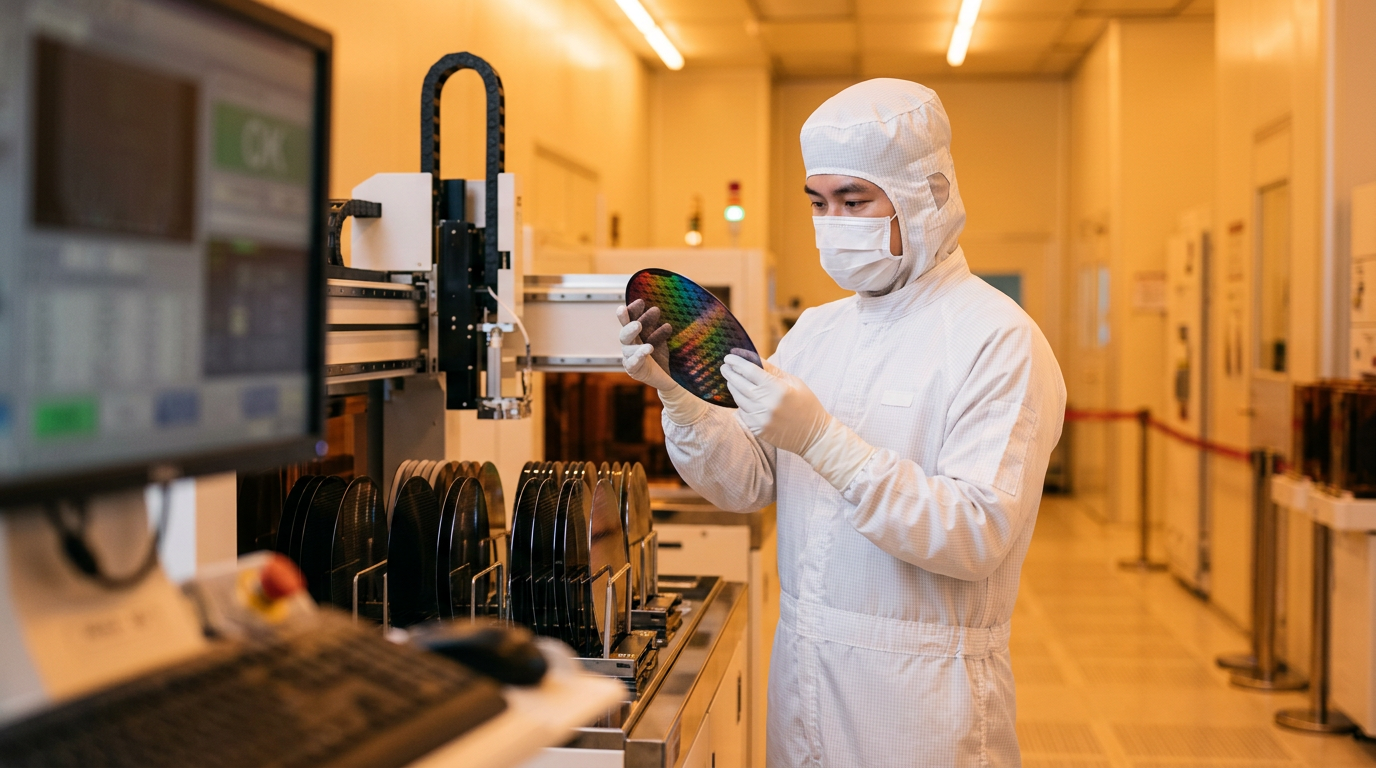
Here’s the thing about Taiwan Semiconductor Manufacturing. It doesn’t make AI headlines the way Nvidia does. It doesn’t get the cloud speculation of an AWS or an Azure. It just quietly manufactures the advanced chips that power all of it — and it reports Q2 earnings on July 16, before the market opens.
Four days away.
What the numbers already say
This isn’t a speculative story. TSMC reported Q1 2026 consolidated revenue of NT$1,134.10 billion, with diluted EPS of NT$22.08. Year-over-year, first quarter revenue increased 35.1%, while net income and diluted EPS both increased 58.3%. That’s not a blip. That’s compounding. Gross margin for the quarter came in at 66.2%, operating margin 58.1%, and net profit margin 50.5%.
And the Q2 bar they set for themselves is just as aggressive. Management guided second-quarter revenues of $39.0 to $40.2 billion, with gross margin projected at 65.5% to 67.5%.
Slight tangent, but it matters. TSMC has now beaten consensus estimates in each of the trailing four quarters, with the average positive surprise being 8.34%.
The demand side isn’t slowing
The company has said demand tied to AI remains robust, driven by hyperscale data center buildouts and ongoing AI adoption. That’s worth sitting with for a second. We’re not still in the first inning of AI chip demand.
In Q1 2026, 7nm and below accounted for 74% of wafer revenue — 36% from 5nm and 25% from 3nm. No competitor is close. Intel Foundry is still working through operating losses. GlobalFoundries tops out at 12nm by design choice. The moat isn’t theoretical. It’s operational.
The pricing power story is getting louder too. Ahead of results, the company has reportedly told customers to prepare for price increases across advanced nodes — a mix that accounts for roughly three-quarters of its wafer business. You don’t ask Apple, Nvidia, and AMD to pay more unless your capacity is genuinely constrained.
What analysts are watching on July 16
The revenue beat is almost priced in. The real signal will be guidance. When TSMC reports on July 16, investors will be watching for updates on demand for AI chips, expansion of its CoWoS advanced packaging capacity, and pricing dynamics for its leading-edge technologies.
Citi and Barclays have both published bullish notes into the print, including a Barclays update that lifted its target meaningfully. Barclays analyst Simon Coles raised his price target to $625 from $470 and reiterated an Overweight rating. That’s a wholesale recalibration of what TSM is worth in a world where every AI dollar flows through its fabs first.
Wall Street analysts expect EPS to climb 52.63% year-over-year to $3.77 for the second quarter. For fiscal 2026, EPS is projected to rise about 44.1% to $15.35.
Options market structure into earnings
This is where it gets interesting for options traders. TSM is not a volatile stock by temperament. It doesn’t move like a small-cap biotech. But earnings consistently create outsized moves relative to the implied range, and the options market ahead of July 16 is pricing that in. The call-to-put flow has been leaning bullish throughout the week, consistent with the broader analyst consensus.
For traders expecting a beat-and-raise scenario, a defined-risk bull call spread in the July 18 or July 25 expiration cycle captures the post-earnings reaction without unlimited exposure to a guidance miss or geopolitical shock. A structure using ATM or slightly OTM calls, with a sold call 10-15% above current price, keeps the risk contained while offering meaningful participation if the guidance upgrade materializes.
For those neutral on direction but expecting movement, an at-the-money straddle using the July 18 expiration allows the position to profit from a significant move in either direction. The risk is IV crush post-announcement if the stock doesn’t move materially beyond the implied range.
The bear case isn’t imaginary. Key risks include margin dilution from N2 and overseas fab ramps, and constraints around advanced packaging capacity. A guidance hold at current levels — rather than an increase — would likely disappoint a market that has priced in upside revision.
The forward look
TSMC has guided to full-year 2026 revenue growth of close to 30% in U.S. dollar terms. Management has also communicated a mid-to-high 50% AI accelerator revenue CAGR through 2029.
What matters here isn’t whether TSMC beats by a few cents. It’s whether management confirms that the demand curve through 2027 remains intact — or whether the first cracks in hyperscaler capex commitments start showing up in the order book. July 16 answers that question. The market is watching closely.
- TSM reports Q2 2026 on July 16, before the market open
- Q2 revenue guidance: $39.0B to $40.2B at guided gross margins of 65.5% to 67.5%
- Consensus Q2 EPS estimate: approximately $3.77, up ~52.6% year-over-year
- Key watch: full-year 2026 revenue guidance revision and leading-edge pricing dynamics
- Bull case: beat-and-raise on guidance, pricing power confirmation, CoWoS capacity expansion update
- Bear case: guidance held flat, N2 margin dilution commentary spooks market, geopolitical escalation
- For traders expecting upside: defined-risk bull call spread in July 18 or July 25 expiry
- For traders neutral on direction: ATM straddle in July 18 expiry captures expected move, with IV crush risk if stock stays range-bound
- Emphasize defined risk on all structures; options involve risk including potential loss of entire premium paid