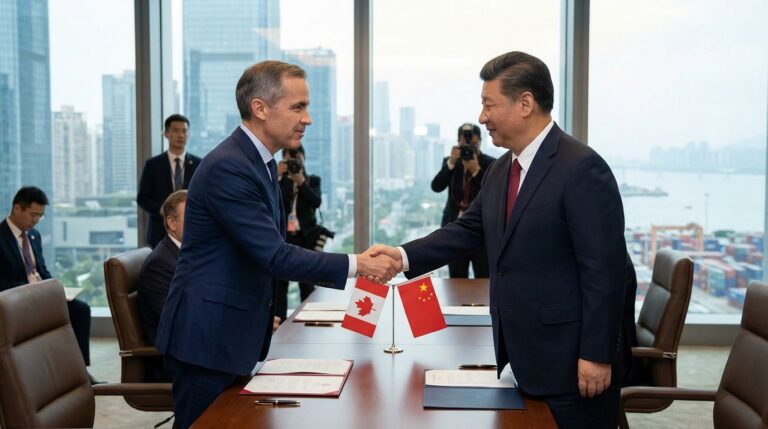

Tomorrow’s calendar is extraordinary. On November 16, the US Department of Commerce filed an interim final rule titled “Addressing Remote Access to Advanced Semiconductors,” and while publication is scheduled for November 19, the Commerce Department said the interim rule took effect immediately when it was issued on November 16. So tomorrow is day three of the policy shock. So is the Trump-Xi summit. The 2026 APEC Economic Leaders’ Meeting is scheduled in Shenzhen from November 18 to 19. These two events are not running in parallel by accident, and trading them as separate stories is the wrong frame.
What the Rule Actually Does
Under the new framework, the goal is to restrict Chinese firms from getting around US chip export controls by renting large-scale computing power abroad, including via data centers in third countries. Separately, a license will be required to export, re-export, or transfer advanced semiconductors to Indonesia, Malaysia, Singapore, Thailand, or Brazil, with an exception for semiconductors destined for companies headquartered in the US, or whose ultimate parent is headquartered in the US, provided reporting requirements are met.
Nvidia’s direct revenue exposure to those five markets is not the point. The bigger threat to Nvidia and AMD is not this rule’s immediate revenue math but Beijing’s response to it.
Beijing’s Counter and the Nine-Day Fuse
China warned the US it would retaliate if Washington proceeds with the curbs, and Beijing’s Ministry of Commerce expressed “strong dissatisfaction and firm opposition” after the US unveiled the sweeping new restrictions. The retaliation lever most likely to move markets is not tariffs. It is minerals.
China has a suspension in place, through November 27, 2026, on restrictions affecting exports to the United States of gallium, germanium, antimony, and dual-use items related to superhard materials. That suspension expires in nine days. If Beijing wants to make a point without writing a fresh headline, it could restore pressure simply by letting the suspension lapse. China is also the dominant producer of primary gallium, and it is the world’s leading producer of refined germanium, which is why this matters.
A lapse of the suspension would tighten supply for compound semiconductors and antimony for munitions, lifting non-China producers such as Perpetua Resources and pressuring US chip supply chains. MP Materials, which owns and operates Mountain Pass, the only rare earth mining and processing site of scale in North America, is the most direct domestic beneficiary if Beijing tightens the minerals flow again. Shares of MP opened at $34.88 Wednesday, and analysts carry a Moderate Buy consensus with an average target near $69.50, roughly double the current price. The stock is already down sharply year-to-date, meaning the asymmetry is substantial if Beijing lets the suspension lapse.
The Positions to Avoid Overnight
Nvidia closed Tuesday at $155.46, trading within a 52-week range of $148.80 to $243.37, meaning it has already surrendered roughly 36% from its high. ASML dropped 1.7% on Tuesday to $1,383.11. Applied Materials closed Tuesday at $349.23, well off its 52-week high of $739.67.
The technical damage in AMAT and ASML is real: ASML’s 50-day moving average is roughly $1,654 and the 200-day roughly $1,602, both far above the current price. Any summit statement that hardens Beijing’s position rather than softens it would hit these names on a structure that is already broken.
Trading Plan
The highest-conviction long into this window is MP Materials. It is the most direct instrument for a minerals-suspension lapse, and MP’s COO and CFO bought stock in mid-November, with insider purchases totaling roughly $3.6 million in that cluster, a credible signal that management does not see the current price as fair. The position would weaken quickly if tonight’s Trump-Xi statement includes an explicit minerals-for-chips truce extension.
Nvidia, AMD, ASML, and AMAT carry two-sided binary risk in the next 48 hours: a productive summit could relieve pressure and trigger a sharp recovery, but a breakdown in talks with the chip rule freshly in force could accelerate the technical selling already underway. Carrying full-size long exposure across those four names into tomorrow morning’s headlines is not a risk-adjusted decision. Scale down or hedge. Watch the summit statement language on technology restrictions first; trade the semiconductor-equipment group only after the diplomatic picture clears.