Fed Chair Kevin Warsh steps to the podium in San Francisco at noon ET today, opening the Federal Reserve’s Productivity and Jobs Task Force conference. It is his first public appearance since the October 28 press conference. What he says in the next two hours sets the tone for a week that includes October retail sales on Tuesday and the October FOMC minutes on Wednesday.
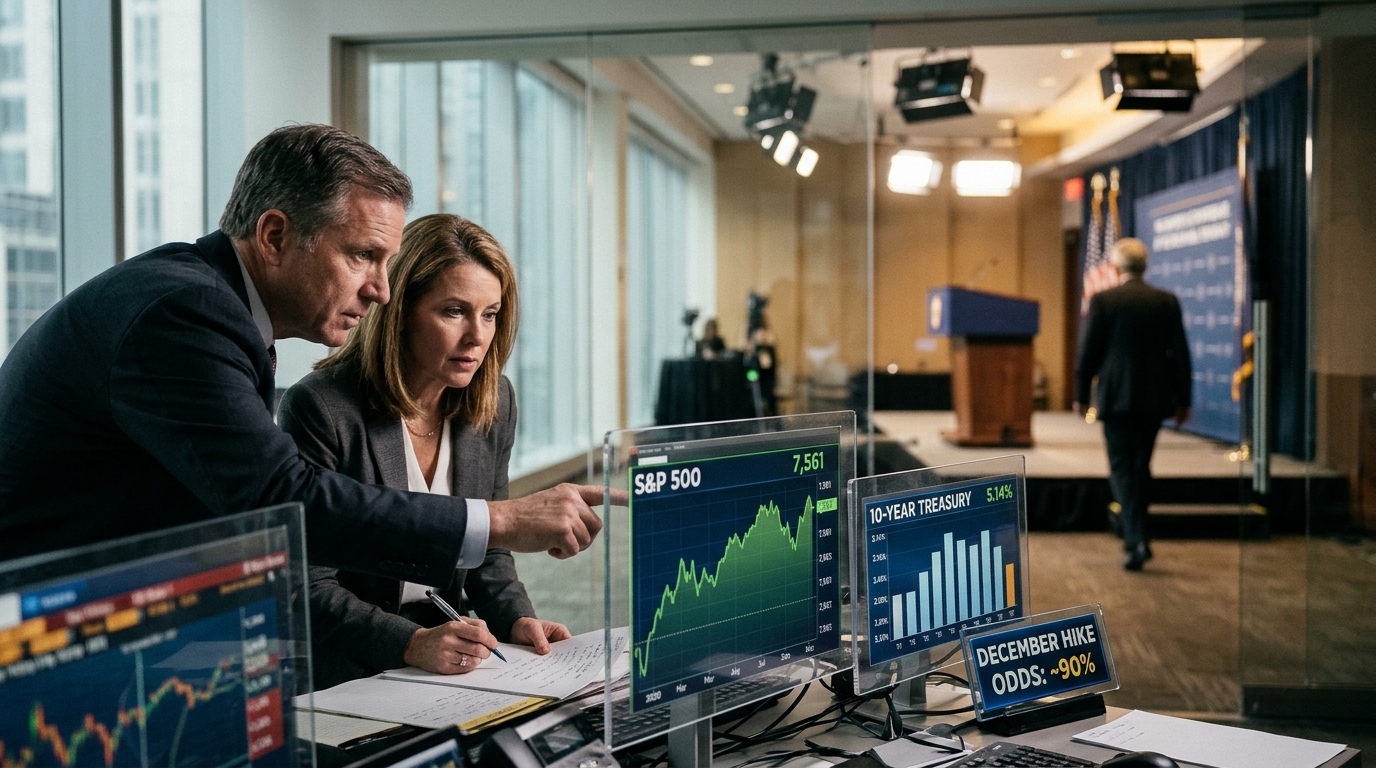
The numbers surrounding this speech are not comfortable for equity bulls. The 10-year Treasury yield is at 5.14%, up sharply over the past week. Kalshi prediction markets price a December 9 hike at roughly 89%, with about 9% assigned to a move larger than 25 basis points. That is not a market hedging its bets; it is a market that has made a decision.
The S&P 500 closed Friday at 7,561.67, a level that reflects neither the current rate environment nor the possibility of a second hike in early 2027. Traders on Kalshi put January 2027 hike odds at about 60%. If Warsh’s remarks today shade hawkish, or if Tuesday’s retail sales beat the flat consensus, the index has limited cushion. Round-number support sits near 7,500.
What Warsh Is Walking Into
The backdrop for today’s conference is a wholesale inflation reading that is impossible to ignore. October PPI came in at 6.5% year-over-year, the highest annual rate since November 2022, even as the monthly figure of 0.3% came in slightly below the 0.4% forecast. The Fed held rates at 3.75%–4.00% at the October meeting, but only by a 10-2 vote; Governors Cook and Cleveland Fed President Beth Hammack dissented in favor of an immediate hike.
The chorus around Warsh has been consistent heading into today. Kansas City Fed President Jeff Schmid said Sunday that inflation is “uncomfortably” above the 2% price stability target and “moving in the wrong direction.” Vice Chair Philip Jefferson said Friday he is taking his policy cues from inflation, noting that PCE was running at 3.6% in September. Boston Fed President Susan Collins backed a steady, gradual pace of hikes but acknowledged the eventual rate path may run higher than she had expected.
None of this means Warsh will step outside the conference’s AI-and-productivity focus to signal December explicitly. His pattern has been to avoid inter-meeting forward guidance. The tell, as one fixed income desk framed it, is whether his language about tightening “beginning to work” is repeated verbatim or gets shaded. Recycled phrasing has historically meant status quo. Fresh language has flagged a shift.
The Week’s Trading Plan
Three events govern the next 72 hours.
Today at noon ET: Warsh’s opening remarks. The AI-optimist scenario, where he frames productivity gains as a future disinflationary force, would give the market room to interpret that as a reason the Fed can stop after one or two more hikes. The hawkish scenario, where he echoes Schmid’s view that AI-driven demand responds to rates like any other demand, backs a longer tightening cycle and reinforces the dollar.
Tuesday at 8:30 a.m. ET: October retail sales. Consensus expects 0.2% growth after September’s 0.8% gain. A print of 0.5% or better reopens the 50-basis-point debate, which Governor Waller put on the table earlier this month. A flat or negative reading is the only near-term relief valve for Treasuries.
Wednesday at 2:00 p.m. ET: The October FOMC minutes land stale by construction, covering a meeting that predated the hot October CPI. Their value is in showing how close the 10-2 majority came to a 9-3 or narrower hold. If the minutes read as a committee already leaning toward December action, the front end will not give back much even if the retail sales number disappoints.
Where the Risk Is Asymmetric
The asymmetry here is straightforward. December is about 90% priced. That means a hawkish Warsh adds maybe another half-point to the 10-year and pressures the S&P 500 toward 7,450–7,500 support. A dovish Warsh, or one that simply stays inside the AI-and-productivity lane, could give equities a brief bid, but the minutes Wednesday will cap any rally. The 5.16% area on the 10-year is the near-term technical resistance; the question is whether this week’s data gives the bond market a reason to test it.
Defensive positioning makes sense ahead of noon. Watch the 2-year yield as the intraday signal: it eased modestly this morning before the speech. Any reversal there after Warsh speaks tells you everything about how the bond market is reading his tone.