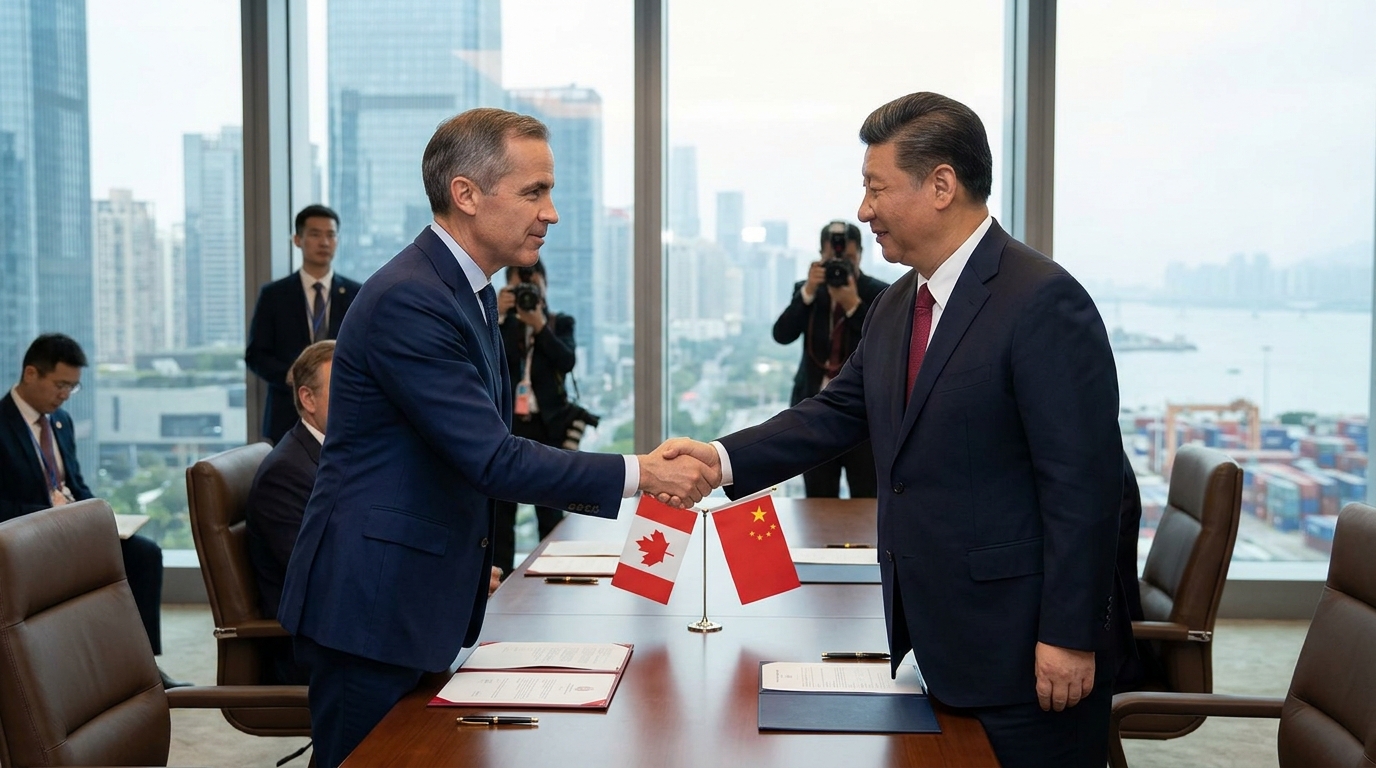
Canadian Prime Minister Mark Carney and Chinese President Xi Jinping agreed Tuesday to further tariff cuts, with Carney’s office confirming the deal after the two held talks in Shenzhen ahead of the APEC Economic Leaders’ Meeting, which runs November 18 to 19. President Donald Trump is expected to arrive in Shenzhen for APEC and to meet Xi and Russian President Vladimir Putin on November 19. That two-day gap is the whole story.
What Was Signed
The deal covers additional tariff relief for about C$400 million in Canadian exports, including frozen pork cuts and fish and seafood. Ottawa said the relief extends to items including cold-water shrimp and prawns, geoduck, sea cucumber, and Greenland halibut.
In exchange, Canada agreed to extend to December 31, 2028, existing remission measures for certain Chinese steel and aluminum products currently set to expire at the end of 2026. That extension expands remission coverage to 32 tariff items (23 steel and 9 aluminum) for which Canadian supply is insufficient or unavailable.
The additional measures build on an agreement launched in January 2026, after Carney visited Beijing. Carney’s office said the expansion also builds on a two-year extension of tariff relief for Canadian exports of canola meal, lobster, crab, and peas that was announced earlier this month.
The Strategic Timing
A major plank of Carney’s economic strategy is to reduce Canada’s heavy reliance on the US, which has imposed hefty tariffs on many Canadian products. Carney said Canada was “well ahead of our schedule” to increase exports to China by 50 percent by the end of this decade.
Shipments of Canadian crude oil to China have risen about 37% in 2026, according to a Reuters calculation based on LSEG data. That is not a coincidence. It reflects a deliberate pivot that the Shenzhen agreement accelerates.
The timing relative to Trump is not incidental. Trump is expected to meet jointly with Xi and Putin on the sidelines of the APEC summit in a first-ever trilateral sit-down, with the meeting framed publicly around nuclear arms control and nonproliferation. Ottawa completing a signed tariff agreement at the same venue, two days prior, is a signal about where Canada sees its trade future, regardless of how that larger meeting resolves.
What Traders Should Watch
- Canadian agriculture and protein exporters. Pork and seafood producers gain direct, confirmed market access in China on improved terms. Watch names with meaningful China revenue exposure.
- Steel and aluminum dynamics. Canadian remissions for covered Chinese steel and aluminum products now run through December 31, 2028, and expand to 32 tariff items. That matters for any North American producer competing in the Canadian market.
- Currency and sovereign spread. A Canada that is actively diversifying away from US trade dependency changes the risk profile of CAD. If the APEC summit produces friction between Trump and Xi on trade, Carney’s pre-positioning looks more valuable, not less.
- APEC headline risk November 18 to 19. The Trump-Xi-Putin meeting has been framed around nuclear arms control and nonproliferation, but any trade language from Trump directed at China, or at Canada’s new bilateral posture, could move related equities and currencies fast.
Bottom Line
This is not a symbolic handshake. About C$400 million in tariff relief, covering specific product categories, is a functioning trade deal. The fact that it was concluded in Shenzhen, on the same stage Trump will occupy in 48 hours, makes the geopolitical context impossible to ignore. Traders in Canadian agricultural names, steel, and CAD pairs should have this on their radar before Wednesday’s open.