
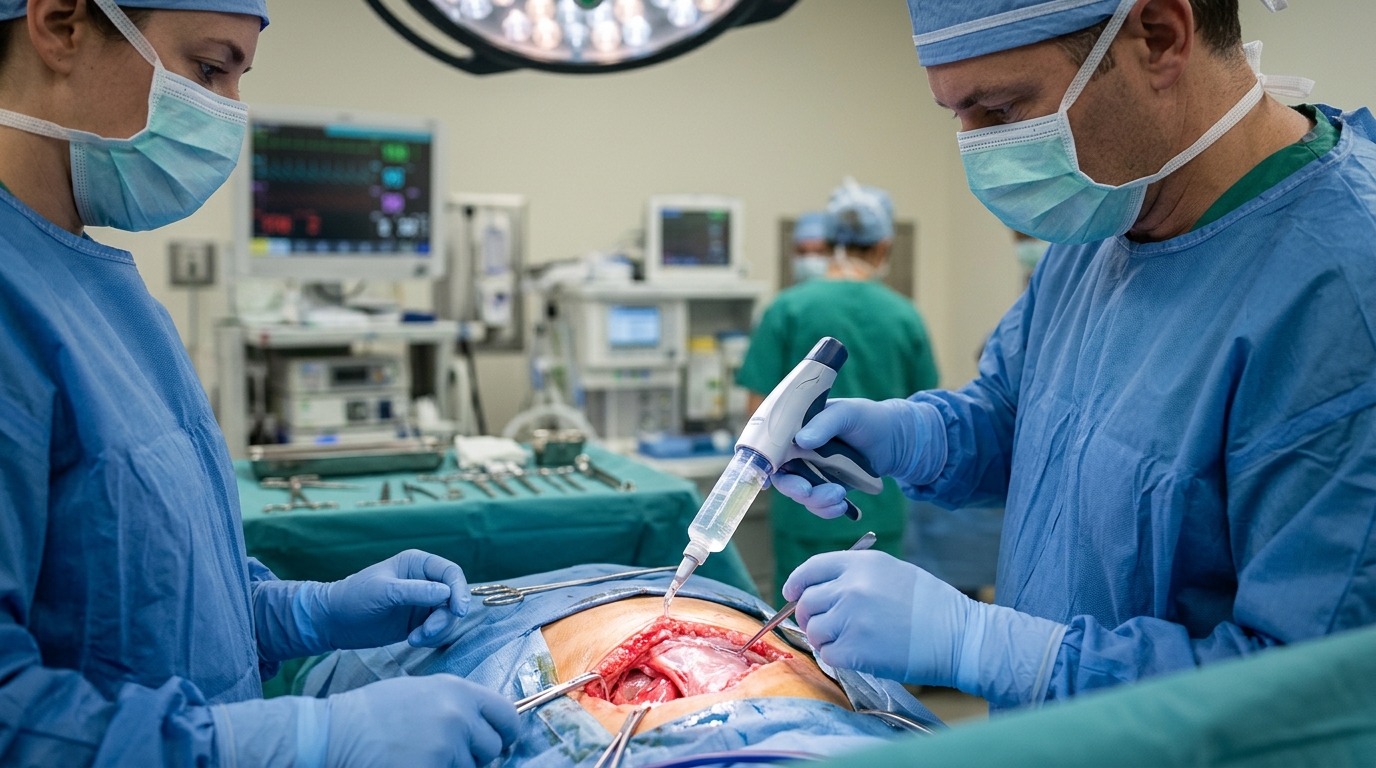
Surgery has not changed its closing act in over a century. A surgeon finishes the hard part, then spends additional time threading sutures or firing a stapler through already-damaged tissue. Sutures and staples can be inadequate in complex procedures and cannot make an air-tight or liquid-tight seal on a lung or artery wound or incision. That limitation is now the center of one of the most consequential races in medical devices.
The timing matters for Medtronic shareholders. Medtronic delivered strong financial performance in FY26, generating $36.364 billion in revenue, up 8.4% reported and 5.8% organically, marking its strongest top-line growth in 10 years. Medical Surgical revenue grew about 5% globally in Q4, including about 8% in the U.S. The segment is performing, but its long-term ceiling depends partly on where surgical closure technology goes next.
Medtronic sells surgical sealants, including DuraSeal, a dural sealant used as an adjunct to sutured dural repair. But Medtronic does not break out sealants and adhesives revenue in its public reporting, so any single-number estimate should be treated cautiously. That said, the category is growing, and market researchers generally expect surgical sealants and adhesives to expand meaningfully over the next decade.
What makes this moment different is the science catching up to the ambition. An MIT spinout called SanaHeal is developing a hydrogel-based adhesive that can rapidly stick to wet tissue and form air- and fluid-tight seals, aiming to reduce reliance on stitches and staples across a range of procedures. SanaHeal says its bioadhesive technology has already received regulatory approval to stop trauma bleeding, and that it plans to enter human trials next year to help control bleeding during surgery and repair various injured tissues. That partnership model is precisely where a company with Medtronic’s surgical distribution reach becomes strategically relevant.
The underlying material science is compelling. In vivo experiments in a porcine model have demonstrated complete sealing of severely leaking lung tissue without sutures or staples, with no sonographic signs of pneumothorax during 14 days of follow-up. The introduction of bioresorbable sealants and adhesives, which can be absorbed by the body over time, is particularly noteworthy because it removes the foreign-body concern that has historically limited adhesive adoption in complex internal procedures.
Medtronic has also been investing in its broader Surgical portfolio, and any credible push in advanced closure would likely come via internal development, partnerships, or acquisitions. That last point is the one worth watching. A well-priced acquisition of an early-stage bioadhesive platform, before human-trial data drives valuations higher, could add a growth vector that the current portfolio does not price in.
The risk is execution speed. Medtronic’s sealant portfolio represents a small portion of its total business, and dedicated specialists with deeper R&D focus remain a threat. Johnson & Johnson’s Ethicon and Baxter both have established sealant franchises and the commercial infrastructure to compete at scale.
The wealth-building takeaway here is straightforward: the suture is not going away next quarter, but the direction of travel is clear. Investors who want exposure to that shift should think of MDT’s sealant ambitions as an option embedded in a larger, already-profitable medical device business. The surgical closure category is expected by many researchers to grow over the next decade, even if forecasts vary widely by source. Who controls the premium tier of that market, and whether Medtronic’s bolt-on strategy gets there first, is the question worth tracking before the next earnings call, which is widely expected to fall on November 17, 2026, although the company may confirm a different date.