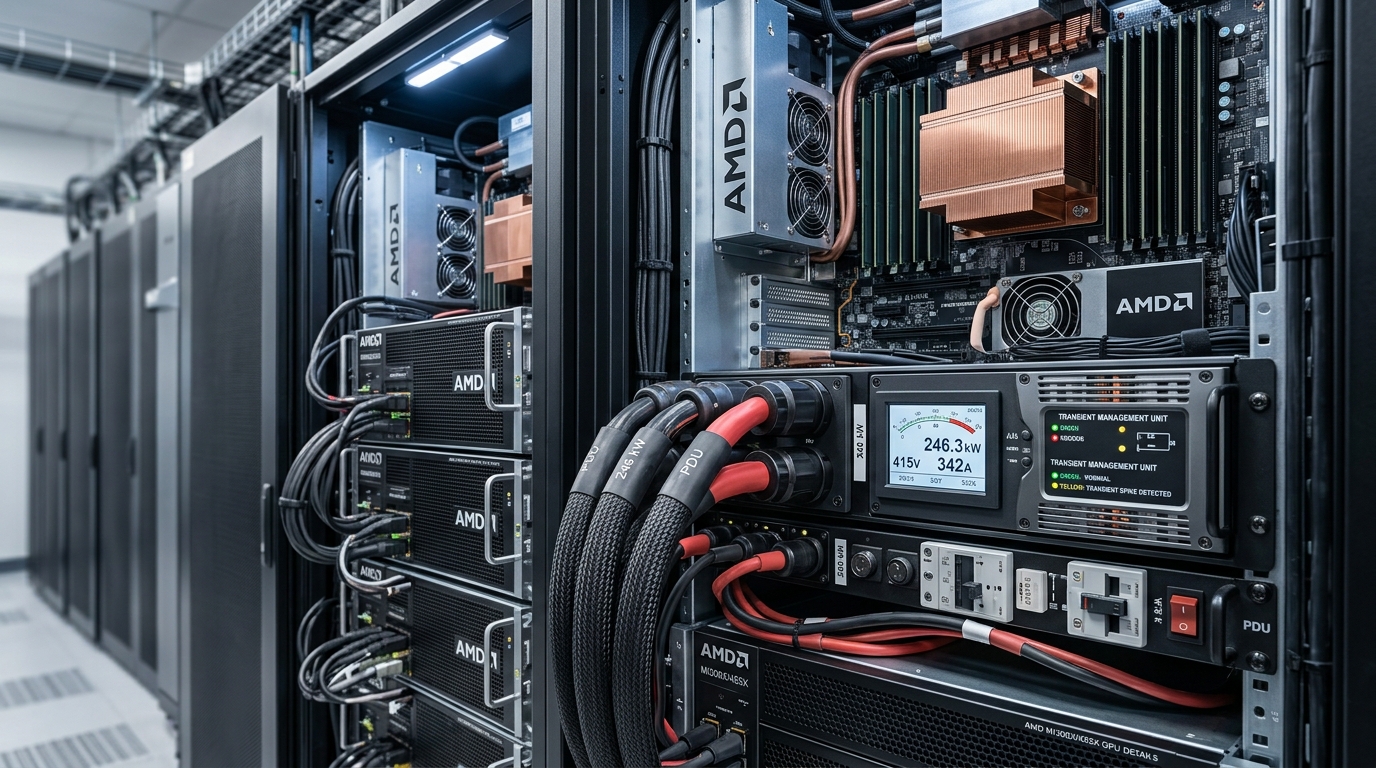
The semiconductor conversation around AMD tends to land on chip counts and FLOPS benchmarks. Those numbers are impressive. A single Helios rack accommodates 72 MI455X GPUs, with FP4 compute peaking at 2.9 EFLOPS and memory bandwidth of 1.4 PB/s (AMD specs are based on engineering projections). But the figure that keeps data center operators up at night sits on the electrical side: high-density AI workloads reaching 246 kW per single rack.
At that power draw, voltage transients become a structural risk, not an edge case. Deep-learning training is not a steady-state workload. Clusters cycle through compute-heavy phases and memory-bound phases in rapid succession, and each transition creates a demand spike on the power distribution network. A rack that briefly swings 20 to 30 kW above its nominal draw can pull neighboring nodes below safe operating voltage, triggering thermal throttling across an entire pod. At 246 kilowatts, a Helios rack requires direct coordination between the computing equipment and facility systems, including an electrical design that handles steady load, transient behavior, protection settings, and failure scenarios.
AMD’s answer is architectural rather than reactive. The Helios rackscale solution is built around open standards including OCP Open Rack Wide, UALink, and the Ultra Ethernet Consortium, aiming to make high-performance AI clusters more repeatable at scale. On the facility side, AMD and Schneider Electric announced a jointly developed reference design in San Francisco on July 23, 2026. That reference design targets liquid cooling that can remove up to 84% of heat, with a power usage effectiveness as low as 1.12 at full load.
Energy efficiency optimization runs through process technology and system co-design, with system-level power consumption management including dynamic voltage and frequency adjustment and coordinated thermal design. Those dynamic controls are what can suppress the worst transient behavior: by anticipating workload phase shifts and adjusting voltage rails ahead of a demand surge, the system can reduce sudden current draw that static power delivery may struggle to absorb cleanly.
The broader commercial stakes are substantial. AMD and Meta agreed to a definitive multi-year partnership to deploy up to 6 gigawatts of AMD Instinct GPUs, with shipments supporting the first gigawatt deployment expected to begin in the second half of 2026, built on the Helios rack-scale architecture. Microsoft has also said it will deploy the AMD Helios rackscale solution to support Azure AI services.
AMD says it has reached an estimated 4x increase in AI energy efficiency from 2024 to 2026. If that efficiency holds at gigawatt deployment scale, power management inside the rack stops being an engineering footnote and starts being a competitive moat. The investors watching AMD’s data center revenue line should watch the kilowatt-per-token metric just as closely.