
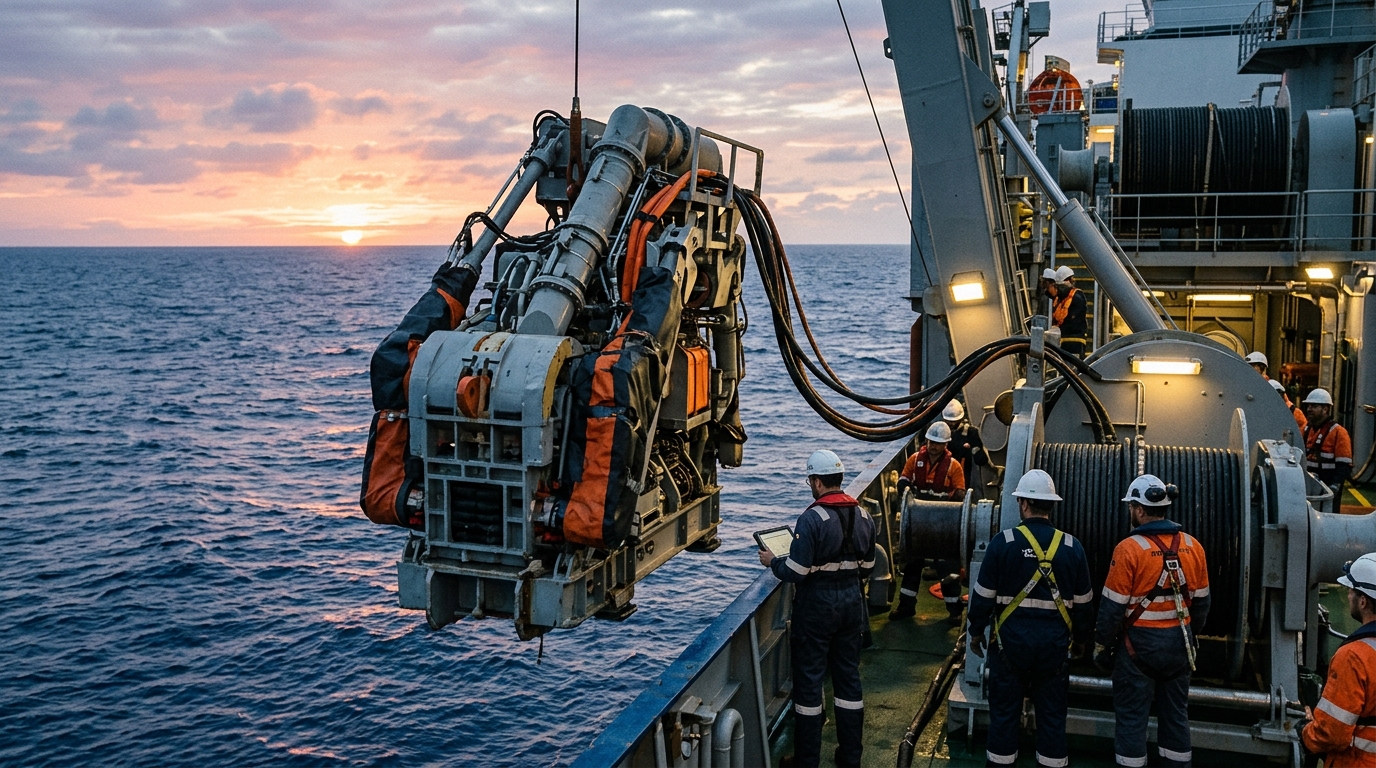
The real action in deep-sea mineral extraction is not in the exploration licenses. It is in the machinery, and this year the machinery race moved from concept to contract.
The Metals Company (Nasdaq: TMC) signed a commercial agreement with offshore engineering giant Allseas in May 2026 to develop and operate what the companies describe as the world’s first commercial deep-sea nodule recovery system. The target resource is the Clarion-Clipperton Zone, a stretch of Pacific seafloor between Hawaii and Mexico that has attracted more capital and regulatory attention than any other seabed province on earth.
The commercial system will carry a nameplate production capacity of 3 million wet tonnes per annum, with the surface vessel Hidden Gem receiving nodules collected by two collector vehicles operating at depths of over 4 km. Under the agreement, Allseas will fund a significant portion of development costs, recoverable through future production revenue. That structure matters: it turns a Swiss offshore contractor, best known for deepwater pipe-laying, into a more direct economic stakeholder in a battery-metals supply chain.
The zones TMC holds are projected to contain 15.5 million tonnes of nickel, 12.8 million tonnes of copper, 2 million tonnes of cobalt, and 345 million tonnes of manganese. Battery manufacturers paying spot prices for conflict-linked cobalt from the DRC should find those numbers clarifying. Some battery and industrial buyers have paid premiums for responsibly sourced or traceable cobalt, and seabed cobalt proponents argue it could command a similar premium by reducing concerns tied to artisanal mining and displacement.
The engineering hurdles are genuine. Operating at pressures hundreds of times greater than atmospheric pressure makes subsea engineering significantly more complicated and expensive the deeper you go. Capital costs for first-generation commercial systems are widely debated and vary by project assumptions, but they are generally expected to be large relative to many terrestrial cobalt projects. Those are not numbers that attract generalist mining capital easily.
Then there is the regulatory layer. NOAA scheduled a virtual public hearing on TMC USA’s consolidated application for October 13, 2026, with the public comment period running through October 19, 2026. The ISA’s council spent considerable time in July 2026 negotiating the rules that would govern commercial deep-sea mining exploitation, but the mining code remains unfinished. TMC is threading the needle by pursuing permits under U.S. law rather than waiting for the ISA deadlock to resolve.
Meanwhile, a different engineering philosophy is gaining traction. Impossible Metals is developing a hovering robotic system that gathers polymetallic nodules; its Eureka III vehicle concept hovers above the ocean floor rather than crossing it, using robotic arms to select and lift individual nodules. In August 2026, the Eureka II vehicle recovered itself from the ocean fully autonomously. That milestone is modest in commercial terms but material in engineering credibility.
The contractor angle is where traders should focus. Engineering for critical long-lead components, including the 4-km riser pipe and launch and recovery systems, is already complete, with subcontract awards targeted by end of Q3 2026. TMC anticipates system commissioning will begin in Q4 2027, subject to permits. Oil States International (NYSE: OIS) has been selected by Allseas to supply a deepsea minerals riser system for the Hidden Gem, and the company markets its Merlin connector technology for ultradeep applications up to 6,000 meters. That is the listed name in the supply chain most investors have not priced yet.