
Hey there, bargain hunter.
Most people chasing the AI trade are looking at chips. Some are looking at power. Almost nobody is looking at what connects all of it together.
That is where Ciena lives.
CIEN has been one of the most overlooked stories in the market this year. Up more than 300% over the last 12 months. Revenue growing 40% year over year. A $7.7 billion backlog that keeps climbing. And still sitting about 34% below its 52-week high of $637.51 (set on June 3, 2026) as of mid-July.
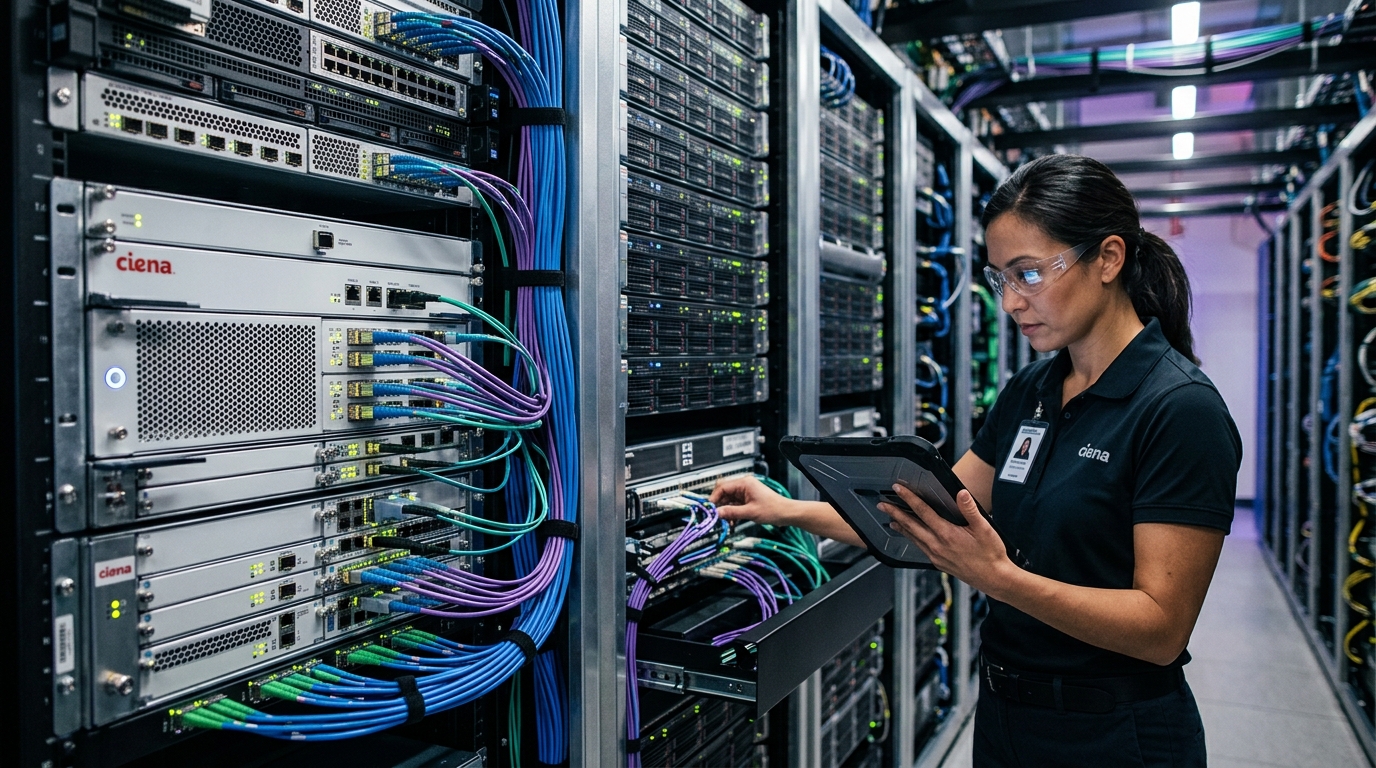
This is an optical networking company. What that actually means is that Ciena builds the hardware and software that moves data across networks at enormous scale. Think of it as the plumbing inside AI infrastructure. Every hyperscaler building massive GPU clusters needs bandwidth between those clusters. Ciena is one of the companies selling that bandwidth infrastructure.
The fiscal Q2 2026 numbers were hard to argue with.
Revenue came in at $1.57 billion, up 40% year over year. Adjusted EPS hit $1.64, up 290% year over year and nearly fourfold the year-ago figure. Optical Networking grew 42%, led by the RLS and Waveserver product lines, both up more than 55%. Routing and Switching surged 88% on the ramp of its DCOM data center out-of-band management solution. Direct cloud customer revenue rose 70%.
The company also raised full-year 2026 guidance to $6.3 billion (plus or minus $100 million), implying roughly 32% growth at the midpoint.
Management sees its addressable market approximately doubling to roughly $50 billion by 2029. The RLS Hyper-Rail platform, which won what management described as the industry’s first multi-rail order from a leading hyperscaler, is expected to ship later in 2026 and should contribute more meaningfully in 2027.
Here is the honest part, though.
The valuation is not cheap. Current P/E sits in the triple-digits (depending on the data source and methodology). Insiders have been net sellers recently. At the peak of $637, the stock was pricing in an enormous amount of optimism.
The question worth asking is whether the pullback from that peak is an opportunity or a warning.
Rosenblatt has a $720 price target on the stock. Barclays is at $607. UBS, more cautious, sits at $508. The average analyst target is around $566. But the range of opinion here is unusually wide, which tells you something about how hard this one is to model.
The next earnings date is currently estimated for September 3, 2026 (the company has not confirmed the date). Between now and then, the market is essentially pricing the pace of AI infrastructure build. If hyperscaler capex stays elevated and the Hyper-Rail ramp comes in on schedule, the bears are in trouble. If the AI build slows and order flow softens, the valuation compression has more room to run.
The backlog at $7.7 billion gives good near-term visibility. That number increased by more than $600 million sequentially, which is not a business slowing down.
What’s interesting is that this is not a story about one big customer. Service provider revenue grew 28% alongside the 70% cloud jump. The breadth matters because it reduces the risk of any single hyperscaler pulling back.
Whether the current price is the entry point or the midpoint of a longer correction depends almost entirely on what happens with AI infrastructure spending in the back half of 2026. That is the only bet being made here.
September 3 is going to be a loud data point either way.