Dell Technologies reports Q2 fiscal 2027 results after Tuesday’s close. The headline number will almost certainly impress. Management has provided Q2 revenue guidance ranging from $44 billion to $45 billion, which translates to roughly 49% year-over-year expansion at the midpoint. Wall Street’s consensus prices in a beat. What the market has not yet answered is whether the infrastructure business generating that revenue is a high-quality operation or a volume machine with thin margins.
Why This Stock Now
Dell closed at $472.26 on August 27, within 8% of its $514 high on August 13, after Nvidia’s $96.22 billion quarter validated the demand side of Dell’s order book. Over the twelve months to August 25, Dell Technologies returned 249% against about 20.5% for the S&P 500. That kind of run commands scrutiny going into a report.
The Business
Dell’s Q1 FY2027 was genuinely extraordinary. AI-Optimized Server revenue hit $16.1 billion in a single quarter, up 757% year over year. The company booked $24.4 billion in total AI orders and raised its full-year AI server revenue forecast to roughly $60 billion. Total Q1 revenue came in at $43.8 billion, up 88% year over year. Diluted earnings per share jumped 282% to $5.24.
The demand side is not the question. Dell’s growth is partly driven by enterprise customers choosing to run AI workloads on their own infrastructure rather than purely in the cloud. For industries with strict data governance requirements, including financial services, healthcare, and legal, this is significant. That on-premise trend gives Dell structural staying power.
Why Wall Street Is Paying Attention
According to 27 analysts, the average rating for DELL stock is “Buy,” with the 12-month stock price target at $510.26. Evercore ISI raised its price target on Dell to $550 from $500, keeping an Outperform rating. Mizuho named Dell one of three AI infrastructure stocks to own specifically because data-center financing continues accelerating. The Q1 beat and the Nvidia data-center revenue figure released Wednesday both confirm the end-market is intact.
What’s Driving the Opportunity
Demand for AI-optimized servers is flowing from multiple channels including enterprise clients, neocloud infrastructure providers, and sovereign entities, creating a more diversified revenue stream beyond a single market segment. The quarter concluded with a record $51.3 billion AI backlog, and the company has said its sales pipeline extends several multiples beyond that figure.
That backlog provides genuine revenue visibility. The risk embedded in it is cost. Nvidia has signaled price hikes of more than 15% on some AI server systems, and Dell’s backlog was priced before that move hit fully.
What Could Go Wrong
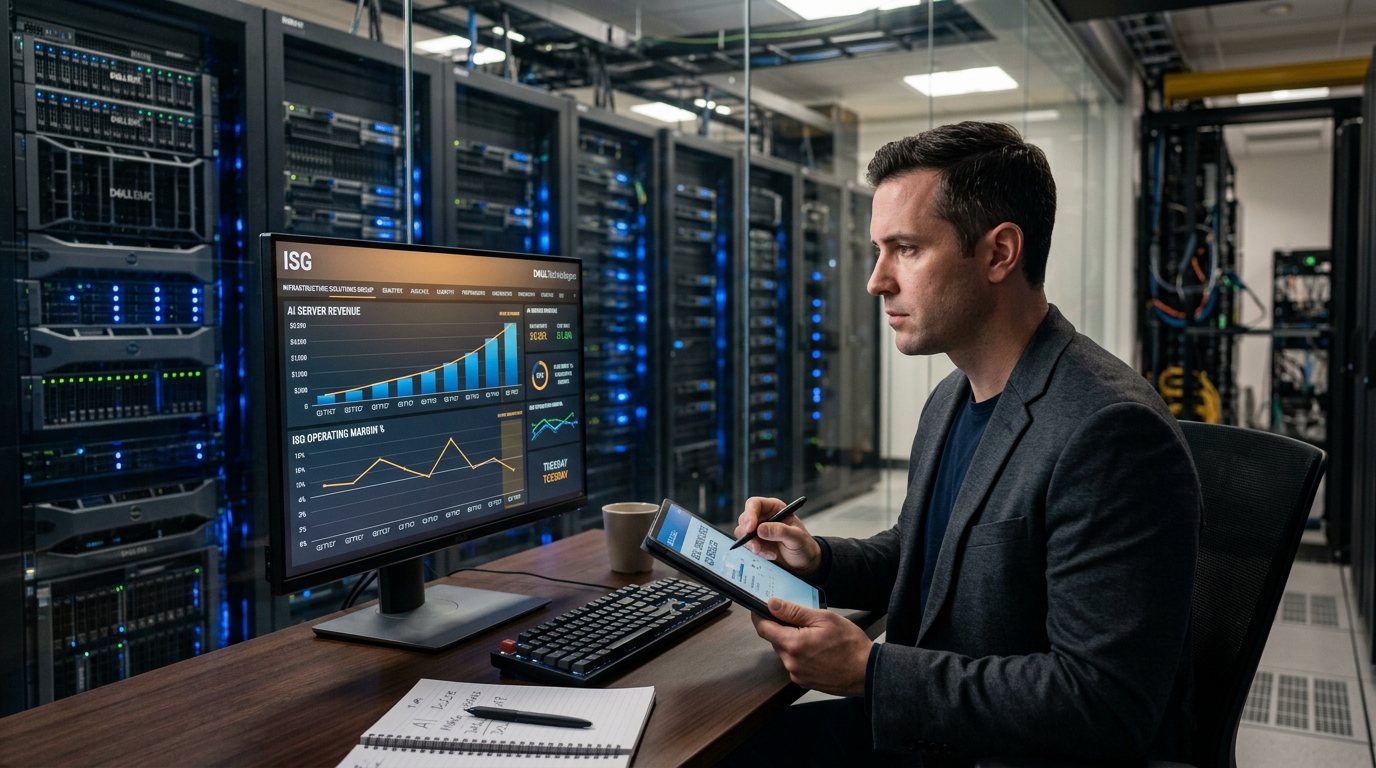
One metric overrides everything else on Tuesday: ISG segment operating margin. The ISG operating margin line, not revenue, not EPS, not the AI-server total, is the segment margin. Above 12% and Dell’s transitory-cost argument is credible and the bull path opens. That margin stood at 10.5% in Q1, down from 14.8% in Q4 FY2026. A second consecutive quarter below that level would confirm that rapid AI server growth is eroding profitability rather than building it.
The full-year AI server guide is roughly $60 billion. Take out Q1’s $16.1 billion and the remaining three quarters average $14.6 billion, below the quarter just delivered. Dell’s own guide implies AI server revenue steps down from here. That deceleration is already in the numbers; the margin trajectory is what is unknown.
The Bottom Line
Dell is the most direct way to own AI infrastructure demand without paying a semiconductor multiple. With AI-optimized server revenue ramping quickly and a record AI backlog, Dell is successfully pivoting toward becoming a scaled AI infrastructure supplier rather than just a traditional hardware vendor. The question on Tuesday is whether that transition is also producing margins worthy of the stock’s near-record price. If ISG margin recovers toward 12%, the bull case at $640 has a foundation. If it prints flat to down again, the bear case at $330 starts to look less extreme.