Most people still think of the AI trade as a chip story. GPUs, custom ASICs, training clusters. That’s one version of it.
The other version is what happens after you install the chips. Those racks run hot. Dense AI workloads generate more heat than anything traditional data center infrastructure was designed to handle. And someone has to solve that problem before a single GPU can run at full speed.
That’s Vertiv’s lane. And it’s been an exceptionally profitable lane in 2026.
VRT is up roughly 84% year-to-date. The stock is trading near $326–$341 after pulling back from a $380 high. The company just came off a strong Q1 report, has a backlog around $15 billion, and is staring down Q2 earnings on July 29 – a date that, for traders, has become the entire near-term narrative in four weeks.
What Vertiv Actually Does
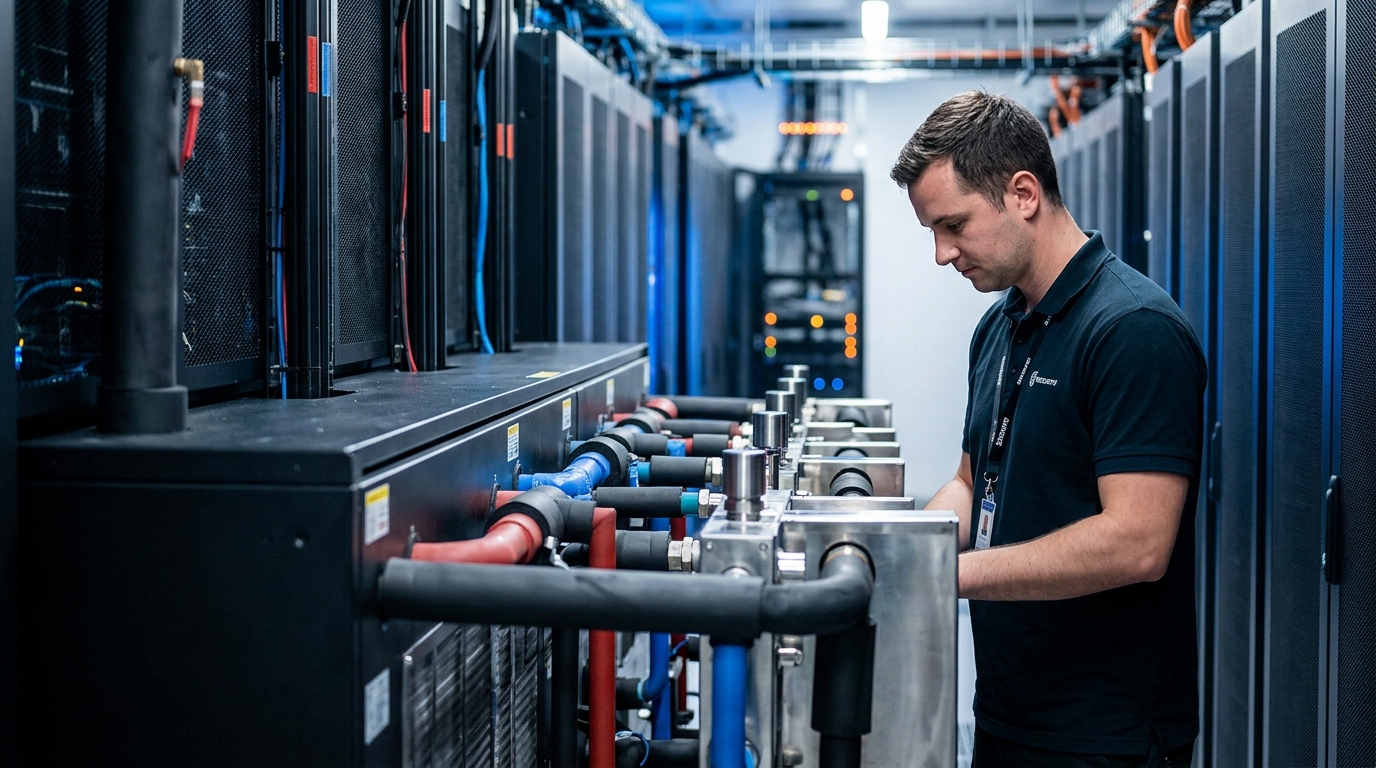
Vertiv designs and sells the physical infrastructure that sits between the utility grid and the server racks: uninterruptible power supplies, switchgear, chillers, computer-room air handlers, liquid cooling distribution units. The company is not a chip play. It’s closer to a utility infrastructure company that happens to be in the most capital-intensive buildout cycle of the past two decades.
The fundamental insight is simple. Every new AI infrastructure build requires power and cooling before any GPU can run. As rack densities increase and AI workloads get more power-hungry, liquid cooling has become a hard requirement rather than an option. Traditional air-based cooling systems are proving insufficient for modern AI clusters. Vertiv is one of the few companies with the scale and product portfolio to deliver integrated thermal solutions at hyperscaler volumes.
The Q1 Numbers Were Not an Accident
Q1 2026 revenue came in at $2.65 billion, up 30.1% year-over-year. The Americas region alone expanded about 44% organically on strong data center demand. Adjusted operating margin hit 20.8%, up 430 basis points from Q1 2025 – that kind of margin expansion alongside 30% revenue growth doesn’t happen in a commodity business. Diluted EPS jumped 136% year-over-year. Adjusted diluted EPS grew 83%.
After those results, management raised its full-year 2026 guidance to $13.5 billion–$14.0 billion in net sales, with adjusted diluted EPS of $6.30–$6.40. Orders momentum going into this year was extraordinary – Q4 2025 organic orders were up approximately 252% compared to the prior year’s fourth quarter.
The backlog now stands around $15 billion.
The Competition Picture
Vertiv doesn’t operate without competition. Eaton, Schneider Electric, and Modine are the primary rivals. Eaton added liquid cooling capabilities through the Boyd Thermal acquisition, which closed on March 12, 2026. Schneider Electric has been expanding its data center power portfolio. The structural question for Vertiv is whether its more direct and concentrated exposure to AI infrastructure keeps it ahead of broader industrial conglomerates who are playing the same theme from a different angle.
Bernstein recently started Vertiv with an Outperform rating and a $416 price target. RBC raised its target to $435. The consensus among analysts tracked on the stock is “Strong Buy,” with an average 12-month price target around $378.
At current prices near $326–$341, the stock still trades at a premium multiple – a premium to Eaton and Schneider. That gap reflects the market’s view that Vertiv’s AI infrastructure concentration warrants a higher multiple. Whether it’s earned depends on whether hyperscalers continue committing to external power and cooling vendors rather than building those capabilities in-house.
What July 29 Actually Tests
Q2 earnings will confirm – or crack – the bull case on several dimensions simultaneously. Backlog conversion: is the ~$15 billion backlog actually translating into revenue at the pace the guidance implies? Margin trajectory: is the 20.8% Q1 adjusted operating margin expanding or compressing as volume ramps? Geographic mix: Americas drove Q1, but international orders growth matters for long-term diversification. And forward commentary: any language around hyperscaler capex commitments pulling forward or slowing down will move the stock significantly in either direction.
A beat and held guidance would likely push VRT back toward the $380 prior high. A miss or a guide-down would pressure it toward the low-$290s, where the Q1 earnings gap fills.
Technical Structure
VRT has been consolidating in the $305–$341 range since the Q1 earnings reaction. Volume has been normalizing after elevated activity post-earnings. The stock is holding above its 50-day moving average, which is constructive. Watch the $305 level as key structural support – a break below it would shift the intermediate-term trend negative. On the upside, $355–$380 represents the zone where the stock spent most of late May before sellers stepped in.
The average earnings move over the past 8 quarters for VRT has been roughly 0.36% – small on average, but the distribution of outcomes is wide. A strong Q2 print could easily produce a 10% or larger move.
Three Scenarios
Bull Case: Q2 revenue beats consensus, likely above $3.2 billion given the raised full-year guide. Margin holds or expands above 21%. Management reiterates or nudges the $13.5–$14 billion full-year range higher. VRT closes the gap to the $380 high and sets up a run toward analyst targets in the $415–$435 range.
Base Case: Q2 revenue lands in line with the raised guidance math, around $3.1–$3.2 billion. Margins are stable. Backlog remains around $15 billion. The stock moves modestly, stays in the $330–$360 range, and sets up for a second-half re-rating as delivery volumes increase.
Bear Case: Margin compression surprises to the downside as tariff mitigation costs or mix shift pressures unit economics. Hyperscaler capex commentary in the quarter turns cautious. The stock breaks below $300 and retests the low-$260s that marked the early-2026 correction lows.
Active Trader Positioning Framework
Four weeks ahead of a binary catalyst is a precise moment in the risk calendar. The time decay on options accelerates meaningfully as you approach the print date, which creates a specific trade-off between defined-risk structures and raw directional positioning. For directional traders, the key question is whether current price around $326–$341 offers enough margin of safety relative to the potential downside in the bear case. For those already long from lower levels, the decision is whether to hold through the July 29 catalyst or reduce into strength.
One thing worth watching that gets less attention: Vertiv agreed to acquire ThermoKey in March 2026 to expand direct-to-site heat rejection manufacturing in Europe and the Middle East, and it completed the acquisition in June 2026. That acquisition adds near-term integration complexity but long-term capacity in a geography where data center construction timelines are compressing.
The AI infrastructure buildout isn’t slowing. If anything, the hyperscaler capex cycle is broadening. Vertiv sits in a position where demand visibility is genuinely strong. What the July 29 quarter will reveal is whether execution is matching that demand in real time.
For informational and educational purposes only. Not investment advice. Trading involves risk, including loss of principal.