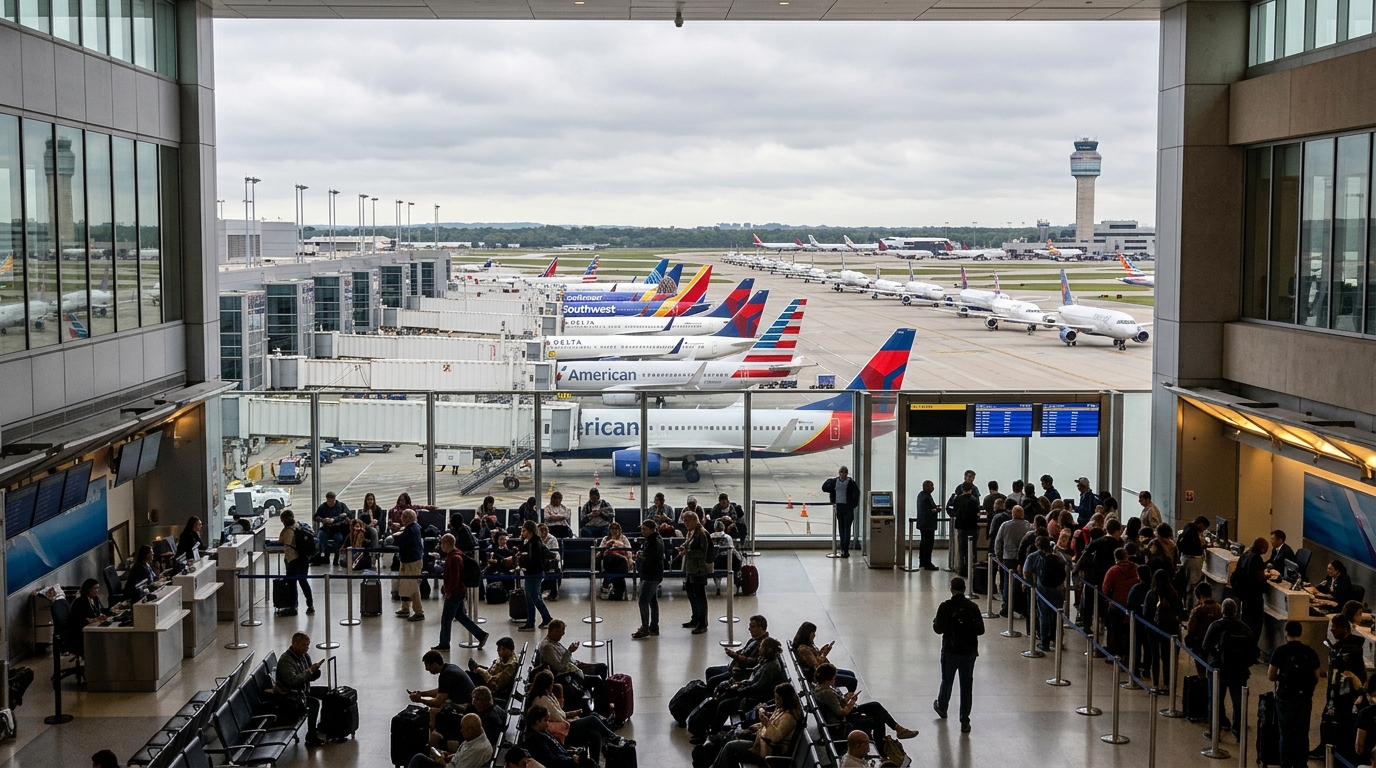
The numbers on Friday should have been ugly. The FAA’s nationwide ground stop that halted US departures for more than four hours did not start with a radar or an airplane, it started in the plumbing: the switches and routers that carry voice and data between the agency’s regional control centers. The US still relies on analog-era telecom equipment in parts of the air traffic control network, and officials said the legacy switches and routers were overwhelmed by data. The result: news organizations, including CBS and Axios, cited FlightAware showing more than 10,000 delays and over 4,000 cancellations by Friday night, with disruptions expected to last into the weekend.
And yet the market shrugged. Almost.
Airline stocks ended modestly lower, led by United (UAL), down about 1.7%, though the advisory landed shortly before the close, and the late timing limited the market reaction. American Airlines (AAL) fell about 1%, the Global Jets ETF (JETS) fell about 0.7%, Southwest (LUV) fell about 0.6%, and Delta (DAL) fell about 0.4%, on a day the broader market was already lower. After the bell, the moves widened but stayed contained, with JetBlue showing the sharpest drop among major carriers in extended trading.
Call it a contained selloff for the longest nationwide aviation shutdown in 25 years. That is a striking number, though context matters enormously. The stop took effect at 3:54 p.m. ET, six minutes before the stock market closed. Traders had almost no time to process the news during regular hours, and by the time the extended session opened, officials were already pointing toward infrastructure failure rather than attack. Homeland Security Secretary Markwayne Mullin said officials had seen “zero evidence” of a cyberattack.
That framing mattered enormously for asset prices. Some cybersecurity names bounced in late trading as traders weighed whether the communication failure had a cyber angle. When the White House briefing emphasized there was no evidence of an attack, any bid looked more like relief than a fundamental re-rating. Separately, Bloomberg reported, citing a person familiar with the matter, that the FBI did not believe the communication issue was due to a cyberattack or criminality, and that one line of inquiry was whether a software update played a role.
The 2023 comparison is instructive here. The only other nationwide ground stop since 9/11 occurred in January 2023, when the FAA suspended domestic departures for about 90 minutes. On that occasion, airline stocks rose on the day. Friday’s stop lasted several times as long and produced a reaction that, in percentage terms, was still modest. The market is absorbing bad news at a pace that would have seemed unusual in earlier cycles.
The question for Monday is whether that composure holds. The first full-session reaction is Monday, November 16, 2026. Airlines open with crew and aircraft still out of position. Aviation analysts warned that the nationwide grounding could disrupt airline schedules for several days. US airlines will not be required to compensate stranded passengers for FAA-caused disruptions under federal rules, which removes one tail risk, but schedule recovery costs are real and cumulative. Thanksgiving is 12 days out.
Where It Shows Up
The obvious exposure sits in the carrier group: AAL, UAL, DAL, LUV, ALK, and JBLU all carry the operational drag of a system reset heading into the busiest travel week of the year. American Airlines stated it was “focused on operating as many remaining flights as possible” while “positioning the airline for the strongest possible recovery.” Recovery language from carriers sounds routine until it isn’t.
The less obvious angle is in the modernization contractors. Officials said the switches and routers were overwhelmed during data transmission, and that the equipment already replaced was not affected, only the older hardware. That framing converts a catastrophic failure into a procurement argument. The overhaul effort accelerated after Congress approved $12.5 billion in funding in 2025 for air traffic control technology improvements. FAA Administrator Bryan Bedford has said Phase One will cost up to $16 billion, leaving a shortfall versus the amount Congress has provided. Friday’s shutdown is now the most vivid argument yet for closing that gap. Leidos (LDOS) and L3Harris (LHX) sit inside the modernization supply chain, though early reporting around vendor updates has been speculative and the root cause has not been publicly pinned on any contractor.
Risks and Counterpoints
The bull case for airlines heading into next week rests on two things: the FAA’s swift confirmation that this was not a security event, and the absence of any airline-specific liability. The bear case is simpler. Friday’s disruption is fresh in the minds of leisure travelers making booking decisions right now. Any softness in Thanksgiving load data would sharpen Monday’s selloff considerably.
The broader market’s near-indifference is worth flagging. Major indexes were already lower before the ground stop hit, and the late timing compressed the immediate price discovery. The snap-back speed reflects a market that is currently pricing events at face value and moving on quickly. It may be right. Or it may be underweighting the second-order effects of a disruption this size entering the highest-traffic week of the calendar.
What to Watch Next
Monday’s open in AAL, UAL, and DAL will give the first clean read on what the market thinks this costs. Watch JETS as a single-ticket proxy. If the group opens flat or rebounds, the market has decided this was a one-day operational disruption with no durable demand consequence. If carriers slide another 2% to 3%, something more pessimistic about Thanksgiving bookings is being priced in. Any definitive root-cause update from investigators will matter for contractors tied to the modernization push. And Congress returns next week. After Friday, the Phase One funding gap is no longer an abstract budget number.