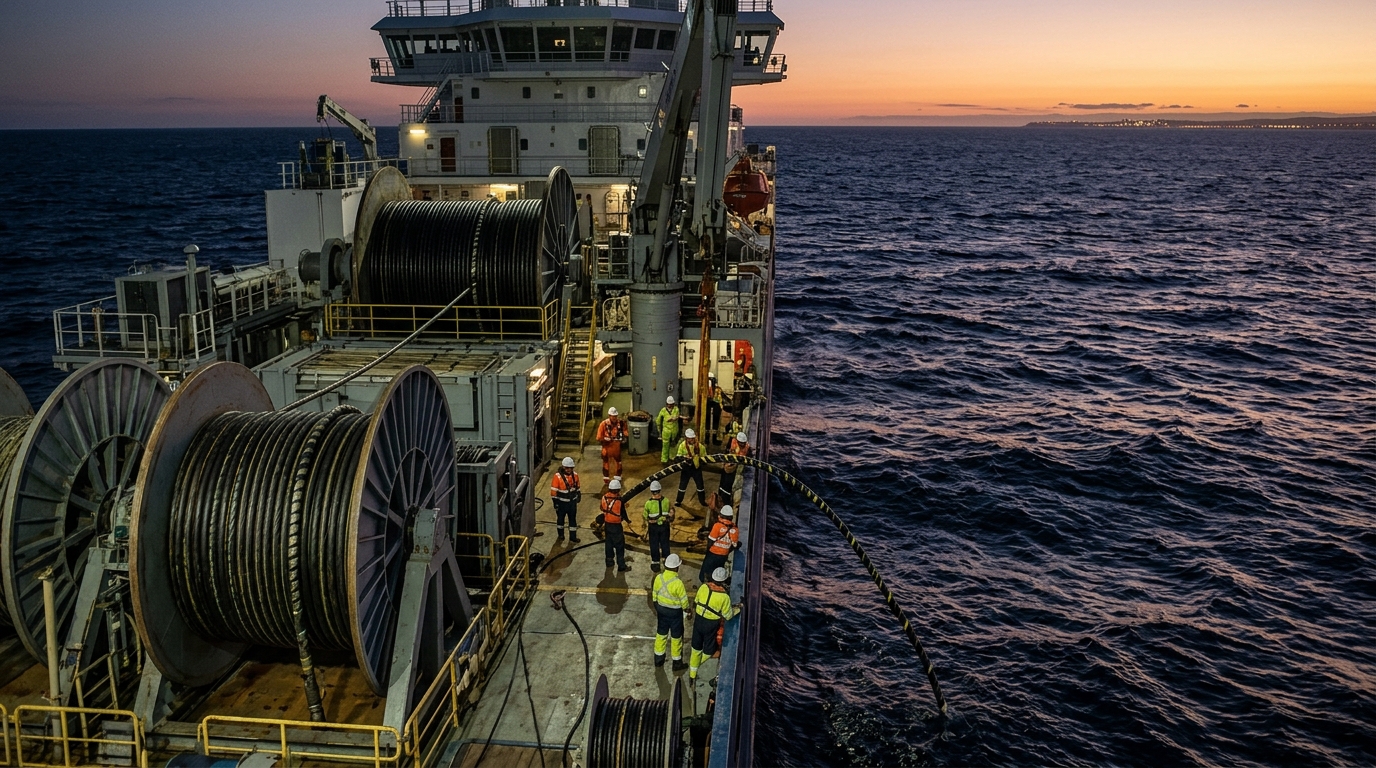
Every transatlantic data line, every AI query routed from a European hyperscaler to an American GPU cluster, every financial transaction clearing between London and New York travels through cables on the ocean floor. When one breaks, the number of ships on earth that can fix it is roughly 60. Of those, only about 19 are dedicated maintenance vessels, while the rest split time between laying new systems and other subsea work. That ratio is the foundation of one of the most durable, least-appreciated capacity constraints in global infrastructure.
The supply problem is about to get structurally worse. By 2040, roughly 65% of cable maintenance vessels are expected to reach the end of their lifespan, and meeting that challenge will require about $3 billion just to sustain current service levels. That translates to 15 replacement vessels and five additional ships to serve growing demand. The industry is not remotely on pace to build them.
The active fleet is already heavily skewed toward older vessels. Rather than commission new purpose-built ships, operators have leaned increasingly toward repurposing second-hand vessels from the oil and gas construction sector. That is a workaround, not a solution.
Who Actually Holds the Backlog
The repair market is controlled by a handful of names. Four vendors, Alcatel Submarine Networks, SubCom, NEC, and HMN Technologies, account for the vast majority of global undersea cable manufacturing and installation capacity. On the repair and maintenance side, ownership is also concentrated, with Orange Marine, SubCom, ASN, Global Marine, and Optic Marine Services among the largest owners of cable ships globally.
The most consequential recent ownership change is Global Marine Group. In March 2025, Keppel Infrastructure Fund and a co-investor acquired a 100% stake in Global Marine Group from J.F. Lehman and Company, marking KIF’s first investment and positioning the fund in one of the world’s largest independent subsea cable solutions providers. Keppel’s rationale was explicit: given limited vessel supply and rising connectivity demand, the market for maintenance and installation services is projected to grow at roughly 45% CAGR from 2023 to 2029, with Global Marine already operating at nearly full fleet utilization.
SubCom has been reported as considering an exit from the maintenance market to focus its ships more heavily on new cable-laying, which would further tighten repair capacity at a time when the number of cables in service keeps growing. If that shift fully materializes, it would effectively transfer pricing power on maintenance contracts to the remaining players.
The Hidden Risk: Permitting, Not Sabotage
The geopolitical dimension gets most of the attention. The damage to cables connecting Finland to Germany and Sweden to Lithuania in November 2024, linked by investigators and reporting to the Chinese-flagged bulk carrier Yi Peng 3, and the Christmas Day 2024 Estlink 2 incident between Finland and Estonia, in which Finnish authorities suspected the tanker Eagle S of damaging the link by dragging its anchor, kept the threat prominent in policy circles. But the repair bottleneck is not primarily a sabotage problem. It is a permitting problem.
Restoration and repair timelines are increasing in some regions, often due to complex permitting processes, fragmented regulatory frameworks, and the limited availability of repair vessels. According to SubTel Forum data cited in industry research, the average repair time has risen from 2015 to 2024, with the average repair time in 2023 at about 40 days. National permitting delays and conflict zone access restrictions will likely extend repair times further, making streamlined diplomatic clearance an increasingly critical element of cable resilience.
Governments are now writing checks to close the gap. In February 2026, the European Commission amended the Connecting Europe Facility Digital work programme to allocate €347 million to strategic submarine cable projects, including a €20 million call to enhance repair capacities, with the Baltic Sea framed as the pilot region for the repair-capacity effort. The UK’s December 18, 2025 government response to a parliamentary committee report said it had set up an Undersea Infrastructure Security Oversight Board to coordinate subsea cable policy, and that it was exploring options around the committee’s recommendation to acquire a sovereign repair ship.
Where the Opportunity Sits
The investment case here is not about cable manufacturing or hyperscaler capex. It is about who controls the vessels when demand for repair time exceeds supply of ship-days. Orange Marine announced construction of two new cable ships in November 2025, focused on maintenance coverage across Europe, Africa, and the Middle East, a direct bet that repair readiness commands a premium. Global Marine, now under Keppel, has signed a contract with Colombo Dockyard for a new purpose-built cable maintenance ship scheduled for delivery in Q4 2029.
The counterargument is real: these vessels are expensive to build, slow to commission, and subject to the same permitting regimes that delay the repairs themselves. A ship contracted today will not work a fault until the early 2030s at best. Investors pricing the maintenance oligopoly at a premium need the $3 billion fleet renewal to happen on schedule, which the history of this industry does not support. What remains true regardless is that the firms holding long-term maintenance contracts against a structurally short repair fleet are collecting a toll that only gets more valuable as the cables multiply and the ships age.