
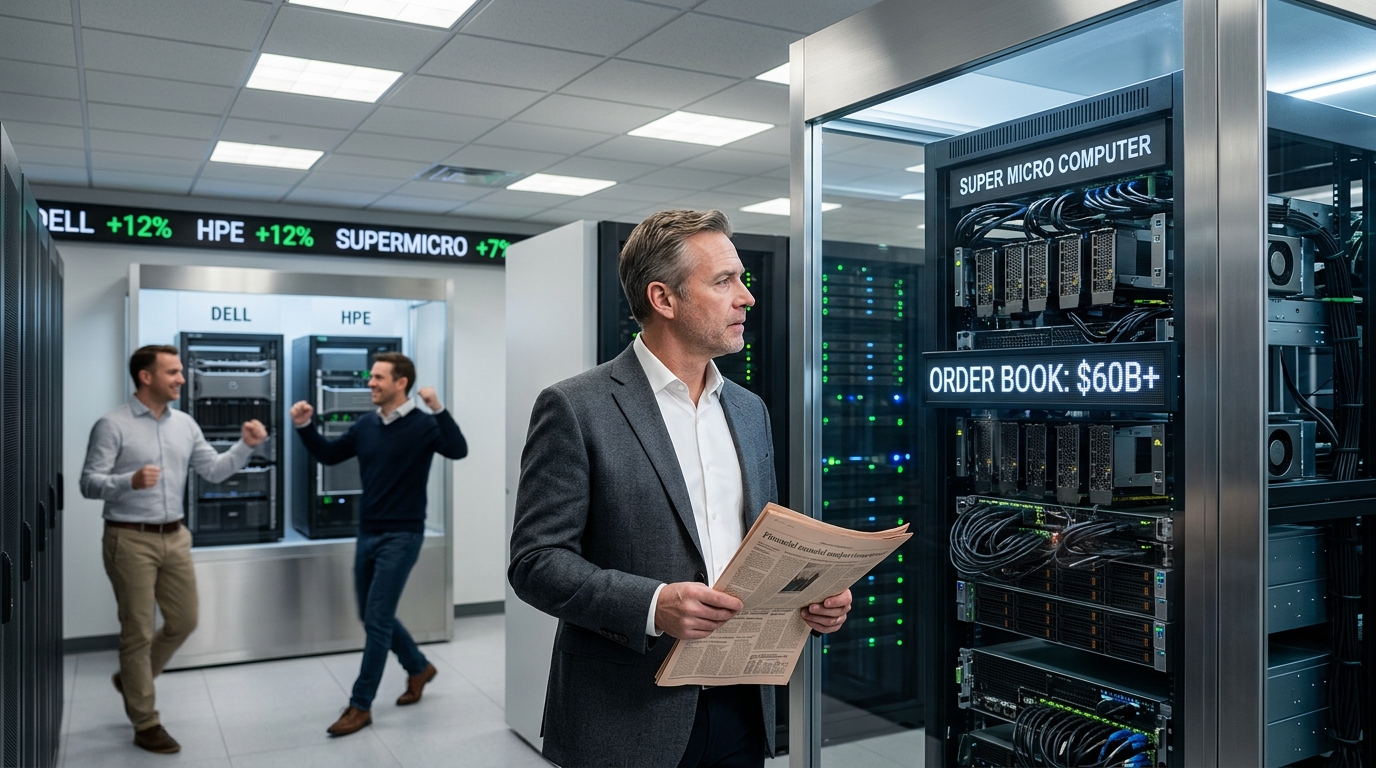
Oracle reported after the close on Thursday. By Friday’s close, Dell was up about 12%, HPE was up about 12%, and Super Micro Computer had added roughly 7% to close at about $40. Same catalyst, same industry, dramatically different reaction. The divergence raises a specific question: why is the company with the largest disclosed order book in AI server hardware also the one with the smallest share-price response?
Why This Stock Matters Now
Oracle delivered first-quarter fiscal 2027 results after the close on September 10, reporting total revenue of $19.3 billion, up 30% year over year, with cloud infrastructure revenue surging 121% to $7.4 billion. Oracle CFO Hilary Maxson reiterated full-year capital expenditure in the range of $90 to $95 billion, with the spending flowing directly to AI rack, cooling, and networking vendors across the hardware supply chain. That guidance is a multi-quarter visibility extension for every hardware vendor in the supply chain.
Super Micro’s smaller gain reflects a partly priced-in story: SVP Mike Staiger had already highlighted a $60 billion order book at a Goldman Sachs conference Thursday. The market had roughly a day to absorb that figure before Oracle added fuel. The result is a stock that moved less on the same news, not because the underlying demand is weaker, but because investors are still wrestling with whether the company can convert that backlog into cash.
The Investment Thesis
In fiscal year 2026, Super Micro’s revenue was $39.1 billion, an increase of about 78% compared to the prior year. Supermicro said it received over $60 billion of new orders in Q4 alone while guiding FY2027 revenue to $65 to $72 billion. At about $40 a share and a market cap around $28 billion, the stock prices in almost none of that backlog’s implied earnings power.
Supermicro grew revenue about 78% in fiscal 2026 and trades around 12 times trailing earnings. This is also where the argument gets more contentious: broad “P/E” comparisons to Dell can be misleading because Dell’s widely quoted multiple is typically based on adjusted earnings and is often far below 40x. The gap in how the market values these businesses is still the thesis in two sentences, but the simple 11x-versus-40x framing overstates it.
The Business Behind the Stock
Supermicro builds AI servers, storage systems, and full data-center infrastructure, selling directly into the hyperscale and enterprise markets that are absorbing Nvidia GPU clusters at scale. Its DCBBS platform bundles compute, networking, power, and cooling into integrated rack solutions, which is increasingly what large customers want. That integrated approach could shift Supermicro toward higher-margin data-center economics over time. Software and services drove about $538 million in fiscal 2026, increasingly bundled with hardware for AI and CPU workloads.
By comparison, Dell has recently discussed an AI server ending backlog figure of $11.7 billion. Supermicro’s disclosed order book is far larger. The challenge is building the servers fast enough to recognize the revenue.
The Working-Capital Problem
This is where the bull case runs into a real constraint. Supermicro’s FY2026 operating cash flow came in at negative $6.8 billion, and inventory ended the year at $12.9 billion. To prefill a $60 billion order book, the company must source GPUs from Nvidia, assemble systems, and wait for customer payment, a cycle that consumes cash before a dollar of revenue lands. One caution: the “$8.8 billion debt and $7.5 billion net debt” figures were disclosed in the company’s May 5, 2026 prepared remarks for fiscal Q3, and they changed meaningfully by year-end. By the August 2026 fiscal Q4 results call, management described total debt around $8.7 billion and net debt around $1.2 billion.
Customer prepayments could materially improve cash conversion as management targets becoming self-funded despite accelerating AI infrastructure deployments. That path exists, but it requires either customers agreeing to prepay at scale or Supermicro successfully tapping capital markets without punishing dilution.
Bull vs. Bear
Bull case: Revenue is projected to reach $65 to $72 billion in fiscal 2027, driven by strong AI adoption, a $60 billion order book, and expansion into enterprise and sovereign markets. At a peer-comparable multiple, the stock would not look like $40. Supermicro raised its fiscal Q4 gross margin outlook to 15% to 17% from prior guidance of 8.2% to 8.4%, citing customer and product mix, which suggests the margin recovery story has more room than skeptics assumed.
Bear case: At roughly 9 times forward earnings, SMCI’s discount reflects cash-flow, margin, concentration, and governance risks rather than weak demand. Key risks include customer concentration, high inventory of $12.9 billion, and negative free cash flow amid rapid expansion efforts. The stock has spent long stretches of 2026 in the $35 to $40 range precisely because those concerns have not been resolved.
What Investors Should Watch Next
Super Micro Computer is next expected to report earnings on November 3, 2026. The key numbers to track are not just revenue, but operating cash flow, inventory levels, and whether customer prepayment terms are shifting. If the $60 billion backlog is converting into actual purchase orders with deposits attached, the working-capital drag shrinks and the valuation case strengthens materially.
Bottom Line
Oracle’s $90 to $95 billion capital spending commitment is structural demand, not a one-quarter surge, and Supermicro sits directly in its path. The order book is real. The revenue ramp is real. What the market is pricing at a discount is the financing required to fund both. Last quarter’s adjusted earnings came in at $1.70 per share versus an estimate around $0.92, an about 85% surprise. The business keeps outrunning expectations. The stock keeps failing to follow. At roughly 12 times trailing earnings against an order book larger than the company’s entire annual revenue, Friday’s roughly 7% gain may be remembered as the day the gap started to close.