
There’s a capital reallocation happening at a scale most portfolio managers haven’t fully mapped. It’s not hedge funds. It’s not retail. It’s state-owned money — and it’s moving faster than it ever has.
Sovereign wealth funds reached $15 trillion in AUM in 2025, reflecting a 10.3% CAGR and outpacing every other class of institutional investor. That growth rate is not slowing. Collectively, sovereign wealth funds and public pension funds manage an estimated $36 trillion in assets under management, with allocations to private markets increasing by an average of 10% per year.
What’s interesting is where the money is going. Not into passive index funds. Not into government bonds. The long-term advance of private market allocations has continued, supercharged by a surge in investments in digital infrastructure, data centres, and AI technologies, with allocations rising to 29% at end-2025 from 25% at end-2020.
The Middle East is leading this shift — and the numbers are extraordinary. The major Gulf sovereign wealth funds across Qatar, Saudi Arabia, and the UAE collectively manage close to $6 trillion. According to Global SWF, sovereign investors deployed $66 billion into AI and digitalization last year, with Middle East funds leading globally.
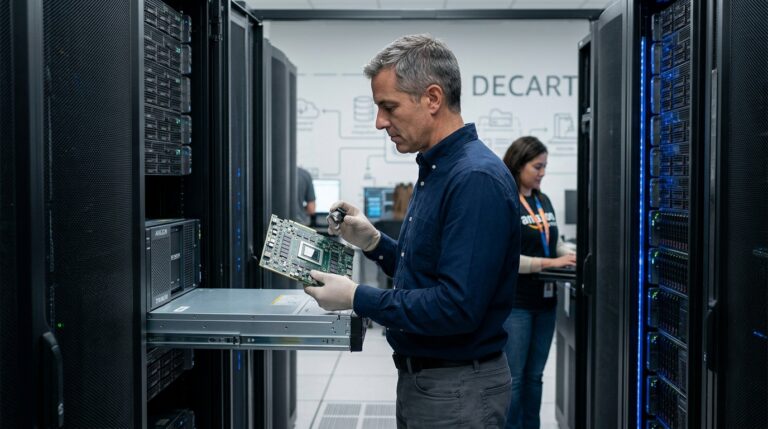
Here’s the part that doesn’t make the front page. Gulf state and Asian sovereign wealth funds are racing to finance hyperscale data centers, chip fabrication, and AI compute capacity as the next frontier in infrastructure investing. Sovereign wealth funds have emerged as the dominant capital source behind the global AI infrastructure buildout, committing an estimated $120 billion in 2025 and 2026 to data centers, semiconductor fabrication plants, and high-performance computing networks.
Jack Selby of Thiel Capital highlights that Middle Eastern sovereign wealth funds account for about a quarter of global AI investments over the next five years. A quarter. That’s not a rounding error on the AI capex story — that’s load-bearing capital.
The stocks most directly exposed to this flow are not the ones most investors are watching. The AI Infrastructure Partnership — a vehicle backed by Abu Dhabi-based MGX, the Kuwait Investment Authority and Singapore’s Temasek, alongside private sector investors — is investing heavily in digital infrastructure, acquiring a controlling stake in Aligned Data Centers at an approximate $40 billion valuation. Data center REITs, power infrastructure, and cooling technology companies all sit in the direct path of this capital.
The geopolitical risk is real and worth naming. The escalation of tensions between the US, Iran and Israel has introduced a layer of uncertainty into that ambition. While the region continues to invest heavily in AI clusters and large-scale data infrastructure, geopolitical risks are becoming part of the strategic equation.
What’s the bull case against that risk? Sovereign wealth funds are the ultimate purveyors of long-term capital. As PIF Governor Yasir al-Rumayyan put it: “We measure our returns not in quarters, but in decades.”
Sovereign wealth funds have evolved from passive allocators to structural architects of private markets with a defining role in their ongoing development. That transformation is still early. The funds are building internal deal teams, co-investing directly rather than through intermediaries, and moving into sectors most institutional managers avoid.
The consensus trade in AI infrastructure focuses on Nvidia, the hyperscalers, and the power grid. All valid. What the consensus is underweighting is the sovereign capital layer underneath all of it — the patient, state-backed money that is essentially guaranteeing the buildout regardless of what the next rate decision does. That’s a different kind of floor than most models are pricing in.