
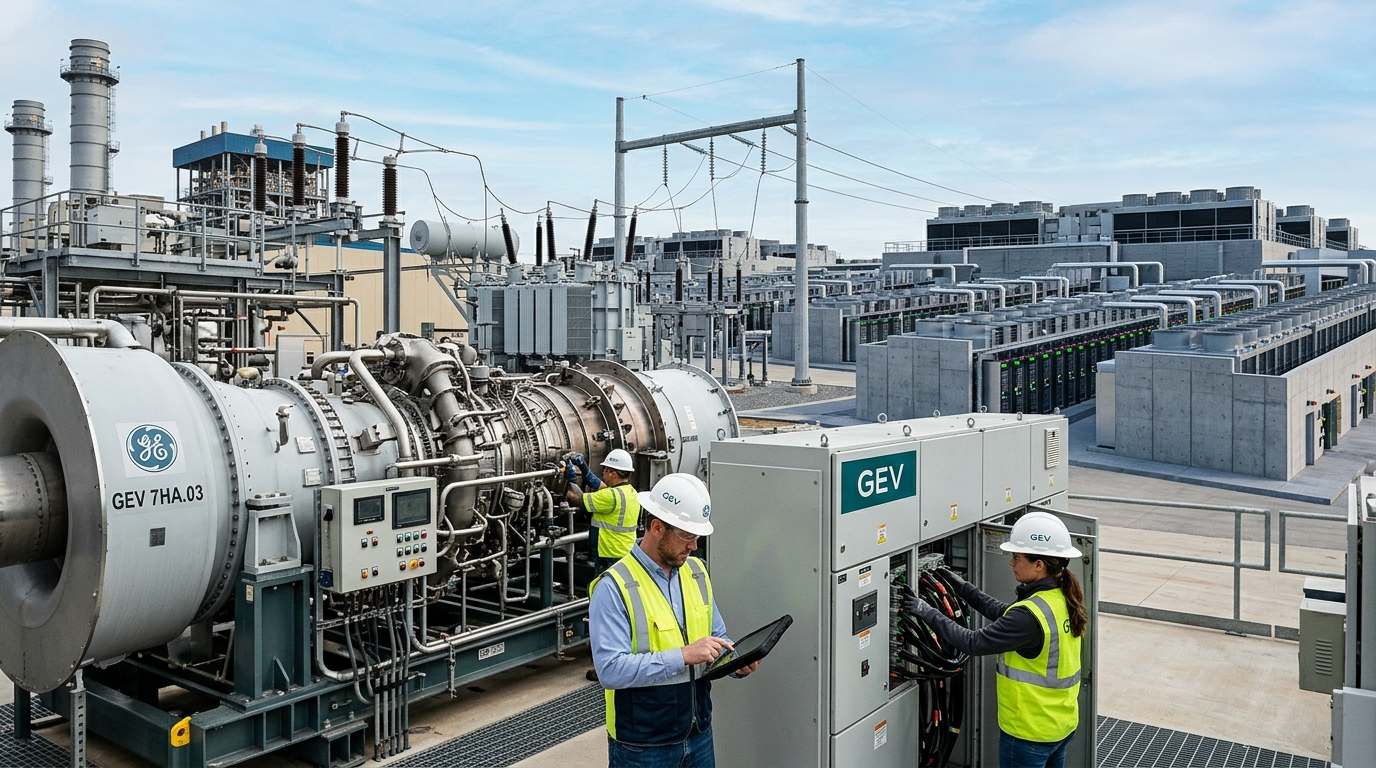
Most of the conversation about the AI trade has stayed in semiconductors and hyperscalers. Meanwhile, GE Vernova has quietly become one of the year’s best-performing large caps — and the reason is simpler than most people think.
Data centers need power. A lot of it. And GE Vernova (NYSE: GEV) builds the gas turbines, grid equipment, and electrification hardware that makes all of it work. That is not a subtle story. It is just one that didn’t get the same headlines as the GPU trade.
The Q1 2026 Numbers Were Striking
In Q1, GE Vernova reported revenue of $9.34 billion — a 16% year-over-year increase that beat Wall Street consensus estimates (roughly $9.2 billion). Adjusted EPS came in at about $2.08 against expectations around $1.83–$1.95. Free cash flow more than quadrupled year-over-year to $4.8 billion. The company’s cash balance hit $10.2 billion.
What really grabbed attention was the order book. GE Vernova booked $18.3 billion in new orders during the quarter — a 71% surge versus the prior year period. The total backlog swelled to $163 billion. In the Electrification segment alone, the company booked $2.4 billion in equipment orders specifically to support data centers in a single quarter — more than all of the prior full year combined.
Management raised full-year 2026 revenue guidance to $44.5–$45.5 billion from a prior range of $44–$45 billion, lifted adjusted EBITDA margin guidance to 12%–14% from 11%–13%, and raised free cash flow expectations to $6.5–$7.5 billion. They also increased the company’s share repurchase authorization to $10 billion (up from $6 billion) and doubled the quarterly dividend to $0.50 per share (from $0.25). The stock jumped about 14% on the day of the Q1 report.
Why This Is Not Just an Energy Stock
Here is where the positioning gets interesting. GE Vernova operates across three segments — Power, Electrification, and Wind. The Wind segment has been a persistent drag; the company is still navigating the Vineyard Wind dispute after a Massachusetts court declined to lift an order keeping GE Vernova on the offshore project while the contract dispute proceeds. That overhang is real and has weighed on sentiment more than once.
But the Power and Electrification segments are doing the heavy lifting. AI hyperscalers — including Amazon, Microsoft, Alphabet, and Meta — are collectively projected to spend hundreds of billions on data centers and AI infrastructure over the next few years. Every one of those data centers needs power generation and grid equipment for distribution and connection, and GE Vernova is a scaled supplier across gas power and electrification hardware.
The company committed $6 billion in capex from 2025 through 2028, alongside $5 billion in R&D investment over the same period. Revenue is forecast to grow at roughly 13% per annum over the next three years, with earnings growth projected at 7% annually over that window.
Valuation — Where It Gets Complicated
GEV is not cheap. The stock currently trades around $1,050 per share, against a 52-week high of $1,181.95.
The trailing P/E is around the low-30s. DCF models from independent analysts range widely.
A few analysts are more cautious. The Wind segment uncertainty is a legitimate earnings wildcard. And CEO Scott Strazik has been careful about forward guidance expectations.
Technical Structure Heading Into Q2
GEV found support in the $1,015–$1,050 range this week after pulling back from the $1,181.95 high. Support levels to watch on the downside: $1,048.60 and $1,015.16. A breakdown below those levels changes the near-term structure. Volume fell slightly on the most recent up day — a minor divergence worth monitoring.
Market cap currently sits around $280–$300 billion.
Three Scenarios Into July 22 Earnings
Bull Case: Q2 order momentum continues at 50%+ growth. Electrification data-center bookings top Q1 levels. Management reaffirms or tightens full-year guidance at the high end of the range. Stock breaks back above the $1,100 resistance zone and rechallenges the $1,181 high. Bull target: $1,200–$1,280.
Base Case: Q2 revenue grows in the mid-teens year-over-year. Orders moderate slightly from the Q1 pace but remain above expectations. Wind segment commentary remains cautious but contained. Stock remains range-bound between $1,000 and $1,150 ahead of earnings, with a post-print move to the $1,150–$1,200 area. Base case: $1,050–$1,180.
Bear Case: Wind segment losses worsen or the Vineyard Wind legal situation escalates. Data center order cadence disappoints vs. the Q1 pace. Management either maintains guidance without raising or narrows expectations toward the lower end. Combined with the stock’s premium valuation, a miss or guidance hold could trigger a 10–15% correction. Bear target: $900–$960.
What Traders Should Be Watching
July 22 is the number that matters. GE Vernova has an official Q2 2026 earnings webcast scheduled for July 22, 2026. The Q1 report was strong enough that it set a high bar for Q2. The electrification data-center order figure is the single most watched metric — Q1’s $2.4 billion in a single quarter, exceeding all of 2025, was the line that moved the stock about 14% in a day. If Q2 matches or extends that, the bull case scenario opens up quickly.
The Wind segment legal situation is the wildcard that doesn’t get priced linearly. It surfaces in headlines unpredictably and tends to knock the stock on bad news days. Traders holding into earnings need to have a clear view on their position sizing relative to that specific risk.
What’s interesting is how GEV has become the quiet consensus name among institutional energy-infrastructure allocators.
The stock is off its high. The backlog is at a record. Q2 earnings are four weeks away.
For informational and educational purposes only. Not investment advice. Trading involves risk, including loss of principal.