
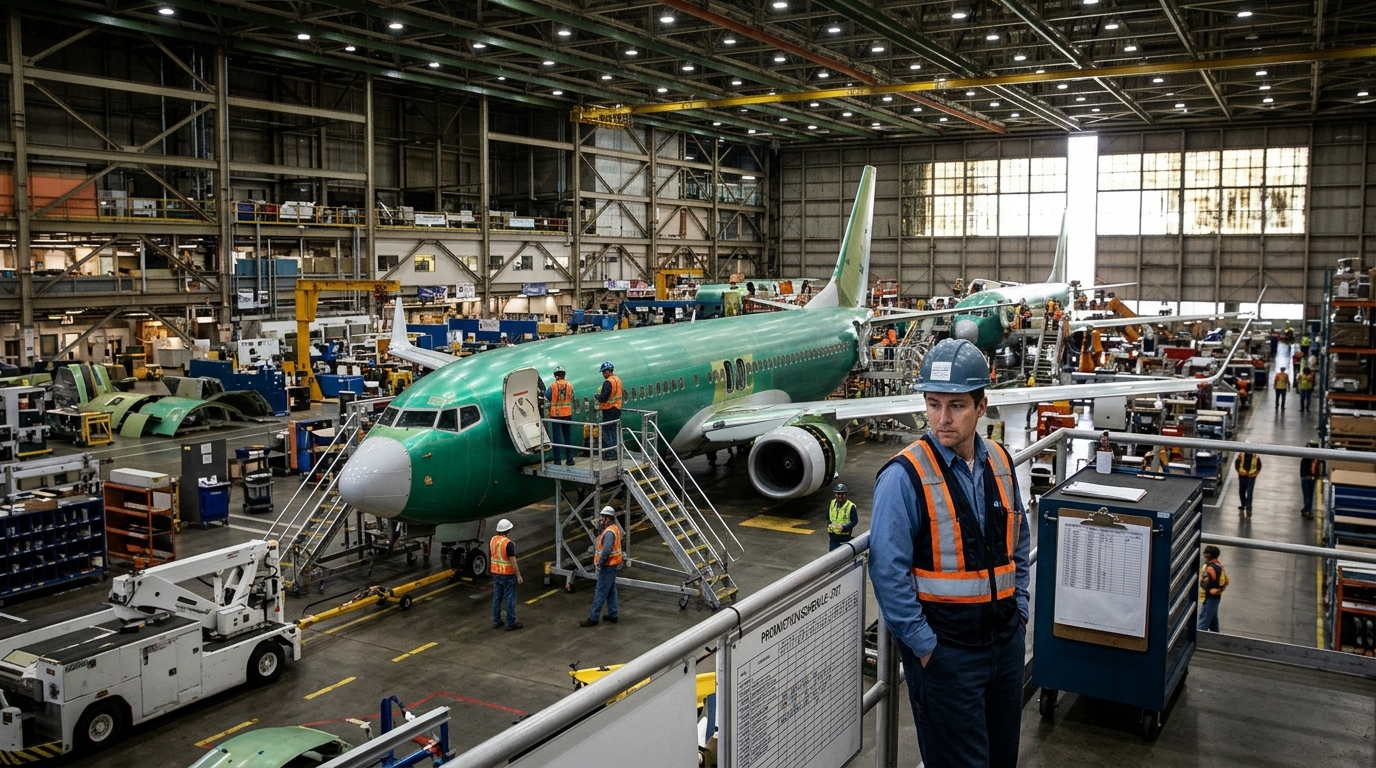
Boeing carries a record $745 billion order backlog and cannot tell its own engineers whether their jobs are safe past December. That tension is not a human-resources footnote. It is the clearest signal yet that the company’s 2027 production ramp is shakier than any official schedule admits.
Shortly after announcing plans to cut 5% of its commercial workforce, Boeing’s management left open the possibility that additional rounds of layoffs could follow, according to SPEEA, the Society of Professional Engineering Employees in Aerospace, which met with Boeing’s senior engineering managers as part of routine workforce discussions. The company had scarce information to share, leaving unanswered questions about which roles could be cut and whether this would be the only round of layoffs. SPEEA said the engineering managers told them they “had not yet determined those facts,” which the committee found “both surprising and frustrating.”
In early November, Boeing announced plans to cut about 5% of its Boeing Commercial Airplanes workforce, roughly 2,500 positions based on the division’s most recently reported headcount. Instead of across-the-board reductions, management plans to target specific teams focused on work statements that are ending or can be ended. Boeing confirmed there will be no options for buyouts or voluntary severance. Notices go out December 9; departures follow February 12.
Read those facts together and the production story writes itself. You do not eliminate engineers whose work is “ending” unless the production plan behind that work has shrunk. The company is trying to increase 737 output from 42 jets a month to 47, a target it had planned to reach by summer 2026. CEO Kelly Ortberg told investors in late October that Boeing now expects to reach that rate in early 2027. Beyond that, Boeing has said its financial plan targets Rate 52 in the second half of 2027.
To reach 52 aircraft per month, Boeing still needs to certify and bring online its North Line facility, stabilize back shops including wings, and get fuselage output in Wichita running at higher rates. CEO Ortberg said the financial plan targets Rate 52 in the back half of 2027. That is a long chain of execution, and each link depends on the engineering workforce that management cannot currently account for.
The bear case is straightforward. Boeing is taking longer than expected to stabilize 737 production at 47 per month, with full stability now expected in 2027, and has said it expects to miss its 2026 target of 500 737 deliveries. The adjusted loss of 34 cents a share in Q3 was worse than analysts expected, and the commercial unit ran a negative 6.5% operating margin on a weaker delivery mix and higher costs. BA is down about 25% year to date, and recently traded in the mid-$150s.
The bull case rests on the backlog and on time. Boeing’s backlog stood at about $745 billion as of September 30, 2026. The commercial airplanes division alone holds a record backlog of about $612 billion covering more than 6,300 aircraft. Airlines still need these planes. Airbus cannot absorb the full shortfall. A buyer who can wait several years for the ramp to stabilize is buying a durable revenue stream, not today’s production rate.
What would change the thesis either way: watch the December 9 layoff notices. If SPEEA reports that cuts are concentrated in finished programs, the damage is contained. If engineering teams tied to active 737 or 777X work are included, that is a direct signal that rate targets are being revised downward again, before management says so publicly. The cadence of monthly delivery figures over the next two quarters matters equally. A line running at 47 planes a month in February 2027 is a different company from one still at 42.
Boeing’s backlog guarantees demand. It does not guarantee execution. Right now, management cannot answer its own engineers’ most basic question about the future. That is not a reason to sell a decade-long recovery story, but it is a reason to price in more slippage than the official schedule shows.