
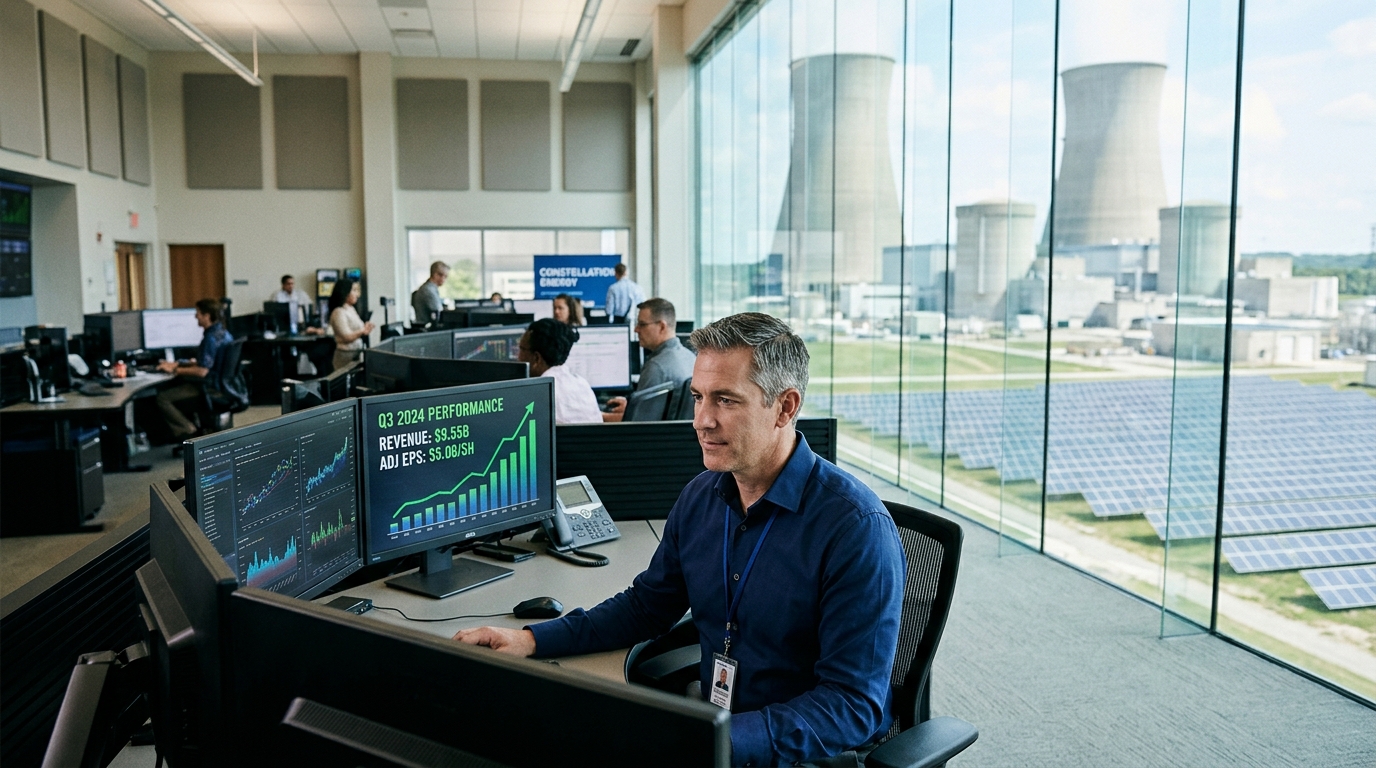
Constellation Energy put up a quarter that Wall Street had no business expecting. The company reported adjusted (non-GAAP) operating earnings of $5.06 per share. Revenue was $9.55 billion. Results came in meaningfully above typical analyst estimates going into the report. That is not a rounding error. A roughly 30% earnings beat at a company this size is a signal worth taking seriously.
The Business
Constellation is the largest producer of carbon-free electricity in the United States, running a fleet that spans nuclear, natural gas, wind, solar, and hydroelectric assets. The company has approximately 31,676 megawatts of generating capacity. Since acquiring Calpine in January 2026, it has also become the country’s leading competitive retail electric supplier, adding a massive natural gas generation business to its core nuclear identity. That combination is exactly what AI-era power buyers need: clean, firm baseload paired with dispatchable gas when load spikes.
Why Wall Street Is Paying Attention
Adjusted operating earnings rose about 66% year over year, and the Google deal announced recently is the kind of anchor contract that reshapes a long-term earnings model. The Google collaboration includes a 20-year power purchase agreement that supports more than $4.3 billion of investment across 11 nuclear units in Illinois, Pennsylvania, and New Jersey, and is expected to add about 890 megawatts of incremental capacity to the PJM grid, with the first uprate expected in 2028. Separately, the companies also entered into a 15-year energy supply agreement for an additional 2,700 megawatts in PJM. Amazon is also in the mix: a 20-year agreement includes 690 megawatts of power and supports more than $3 billion in investment at Constellation’s Calvert Cliffs Clean Energy Center, including about 190 megawatts of additional capacity expected online between 2030 and 2032.
Management raised the midpoint and narrowed full-year 2026 adjusted operating earnings guidance to $12.50 to $12.80 per share, up from the prior $11.50 to $12.50 range. That is the second midpoint raise this year. Constellation also received a conditional Department of Energy loan commitment of up to $5 billion to finance nuclear uprates and modernization across its nuclear fleet.
What’s Driving the Opportunity
The company’s uprate plan is central to the story. Management has said these projects will deliver nearly 1,200 megawatts of additional nuclear power, most of it scheduled for completion between 2029 and 2032, with total project costs expected to be approximately $4.3 billion. Management argues those uprates can reach the grid a decade or more before comparable new nuclear construction. The Rhode Island acquisition adds dispatchable gas in ISO New England: Constellation agreed to acquire RISEC Holdings, the owner of the Rhode Island State Energy Center, from Shell Energy North America for $715 million. The facility is a natural gas-fired combined-cycle plant with 609 megawatts of generating capacity.
The long-range numbers are genuinely large. Free cash flow before growth is projected at $8.4 billion across 2026 to 2027 and $11.5 to $13.0 billion across 2028 to 2029. Constellation is targeting 20%-plus compound annual earnings growth from 2026 levels, with base earnings projected to reach $11.40 to $11.90 per share by 2029.
What Could Go Wrong
Here is the tension at the center of this idea. The stock is priced for a future that starts arriving in 2028. Long-term contracted economics ramp from 2028 onward, while most of the planned uprates are scheduled for 2029 to 2032 and total project costs are expected to be about $4.3 billion. The Crane Clean Energy Center restart also remains targeted for the second half of 2027. Between now and then, investors are holding a leveraged bet on execution, regulatory continuity, and power prices staying supportive. Any one of those can slip.
The nuclear production tax credit has bipartisan support, but tax policy does not stand still. The Calpine integration, while ahead of plan through Q3, is still a roughly $16.4 billion equity purchase price deal, plus assumed net debt, being digested. And CEG has been trading in the lower part of its 52-week range and below its 200-day moving average, meaning the stock has already absorbed a significant de-rating from its December 2025 peak of $380.78.
The Bottom Line
Constellation just demonstrated it can operate at a level well above what analysts model. The Google nuclear deal and the Amazon agreement establish that the largest technology buyers in the world are willing to sign 15- to 20-year contracts specifically to secure its output. Morgan Stanley raised its price target on CEG to $391 and maintains an Overweight rating. After Monday’s roughly 10% move, the stock is still valued on what management can deliver over the next several years, not what the cash flow looks like next quarter.
The honest framing: CEG is a high-quality business with a clear growth path, credible customers, and a government backstop on financing. The patient investor buying today is funding a capital deployment cycle that pays off materially in 2028 and beyond. That is the trade. It suits investors who can hold through the construction timeline without needing the cash flows to arrive next quarter.