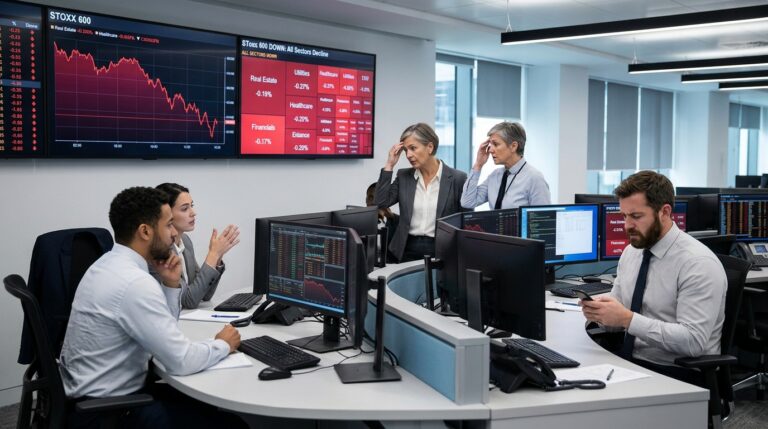

When two markets face the same news and move in opposite directions, at least one of them is misreading it. That is precisely the situation Monday morning: Bitcoin traded near $74,600 on November 9, down roughly 2% over 24 hours after recovering from Sunday’s drop toward $73,500. At almost the same moment, regional equity markets rallied sharply. Taiwan’s Taiex rose 4.9%, Japan’s Nikkei gained 2.3%, and South Korea’s Kospi finished down 0.8% after rising earlier in the session.
Both markets spent last week selling the same set of concerns: AI regulation risk from Democratic midterm victories, Nvidia’s governance controversy, and rising Fed rate-hike expectations. This morning, equities decided those fears were overpriced. Bitcoin did not.
What Broke Down
The proximate cause of Sunday’s Bitcoin collapse was a leverage unwind. Bitcoin’s price fell from $75,690 to $73,477 in 15 minutes as overextended long positions gave way. Total crypto liquidations topped $1 billion over 24 hours, according to CoinGlass data. Reports pegged Ethereum at roughly $455 million of those liquidations versus about $278 million for Bitcoin. Leverage cascades do not explain a direction, only an acceleration. The more revealing pressure came from the institutional channel.
US spot Bitcoin ETFs recorded about $1.282 billion in net outflows during the trading week of November 2 to 6, their largest weekly outflow since late June and their second straight week of net withdrawals. BlackRock’s iShares Bitcoin Trust, IBIT, accounted for about $1.209 billion of that weekly total. Those withdrawals pushed 2026 year-to-date net flows for US spot Bitcoin ETFs below zero. That is not a headline an ETF product wants attached to it eighteen months into its existence.
What the Market May Be Missing
The sharpest signal in this divergence is not the price. It is Strategy’s cost basis. Bitcoin’s drop has taken it below the average acquisition cost of Strategy (MSTR), which held 849,327 BTC as of November 1, acquired for about $64.08 billion at an average price of $75,451 per coin. Bitcoin at $73,731 leaves Strategy about 2.28% below that average cost.
Strategy does not have to sell any Bitcoin simply because the price falls below its cost basis; no mechanism triggers that automatically. But the optics matter for the stock. A Bitcoin close below Strategy’s average cost could hit MSTR’s earnings and investor sentiment far harder than it moves Bitcoin itself, as the cost line feeds the quarterly loss, the premium, and an MSCI index review simultaneously. MSCI is scheduled to announce the results of its November 2026 Index Review on November 11, with changes effective as of the close of November 30. If Strategy is swept into deletions by the new non-operating company screen, passive funds tracking affected MSCI indexes would be expected to sell their MSTR shares at month-end, adding a forced-seller dynamic that has nothing to do with Bitcoin’s fundamentals.
Where It Shows Up
IBIT is the clearest instrument for tracking institutional conviction. When BlackRock’s fund leads outflows for a second consecutive week, it signals that the marginal institutional buyer is stepping back, not simply waiting. COIN and MSTR are both leveraged expressions of the same price: Coinbase derives a substantial portion of trading revenue from crypto volatility, and Strategy’s treasury means its stock functions as a geared Bitcoin position with balance-sheet complications now front and center. ETH’s outsized share of liquidations, over $450 million versus Bitcoin’s $278 million, suggests altcoin books were more dangerously levered going into the move.
Risks and Counterpoints
The equity bulls have a reasonable case. The recovery in Asian equities followed Friday’s rebound on Wall Street, where dip buyers emerged after a volatile week of losses driven partly by concerns that a Democratic-controlled Congress could impose tighter regulation on the AI industry. If that read is correct, and the worst of the regulatory fear is behind us, risk appetite should broaden back into crypto. Bitcoin fell to the low $73,000s before rebounding above $75,000 at points during the session, suggesting buyers do exist near these levels.
The bear case is that crypto’s failure to participate in this morning’s equity bounce is a regime signal, not a lag. Bitcoin tracked equities down last week but is not tracking them up. That asymmetry, if it persists through today’s US session, is worth taking seriously.
What to Watch Next
Investors await US CPI figures on Tuesday, which will either harden or soften the Fed rate-hike bets that have been pressuring both asset classes. Watch whether IBIT sees any reversal of its outflow trend when Monday’s data settles. And the MSCI index review announcement on November 11 carries direct consequences for MSTR and, through sentiment, for Bitcoin itself. Prediction markets currently price a 46.5% chance that Bitcoin dips to $70,000 before November ends. That is a coin flip. What it is not is a consensus that the bottom is in.