
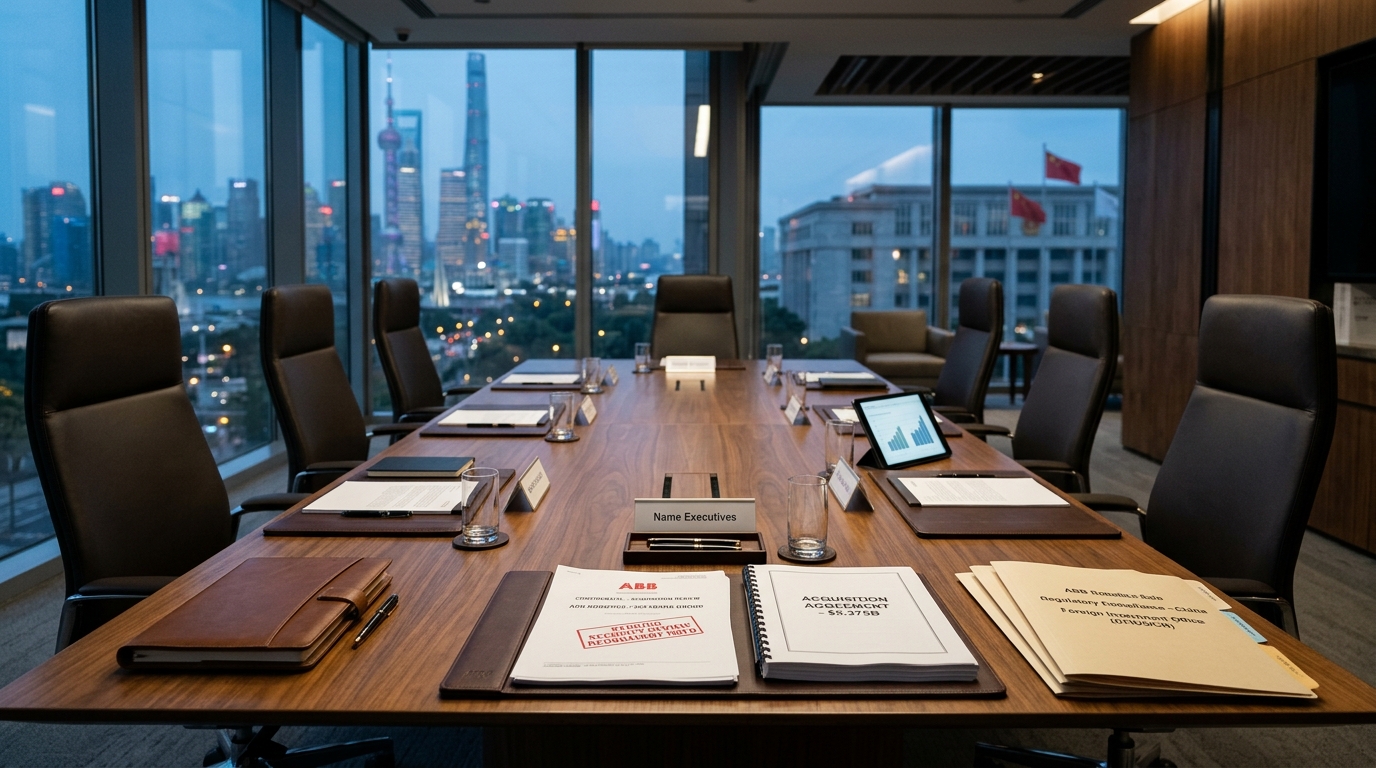
The deal looked clean on paper. SoftBank agreed in October 2025 to buy 100% of ABB’s robotics business for $5.375 billion, with completion planned for mid-to-late 2026. It cleared China’s antitrust review in February 2026 and received European Union merger clearance in March. Then, on November 5, it stopped.
ABB confirmed on November 5 that China’s foreign-investment security review office “has prohibited the acquisition of the ABB Robotics business in China,” covering the China portion of SoftBank’s $5.375 billion deal for the division. SoftBank’s shares fell about 7% in Tokyo on Thursday.
The reason matters more than the result. Public reporting has not established a single, confirmed rationale from Chinese authorities. The concern, as described in press coverage, is that sensitive robotics know-how and operational data could leave China and be used to strengthen AI systems abroad, and SoftBank’s ties to OpenAI have drawn added attention. This is not a traditional antitrust concern about market concentration. It is a claim that robotics data generated inside China belongs, in some meaningful sense, to China. That reasoning applies to any foreign owner of a manufacturing technology platform with a significant Chinese footprint, not just SoftBank.
China is ABB’s biggest robotics market, representing around 30% of its robotics business. China is the largest single market for industrial robotics on earth, and ABB’s unit built much of its scale there. At its peak, the “Big Four” foreign robot makers collectively held more than 70% of China’s industrial robotics market, according to a U.S. government report summarizing Chinese industry commentary. ABB still runs a manufacturing hub in China with a robotics team of more than 2,000 people. Strip that out, and what SoftBank bought looks considerably smaller.
Long-term investors should sit with an uncomfortable question: what is a global industrial franchise actually worth when a single government can carve out its most important market on security grounds, after antitrust clearance, after EU approval, after the deal was signed and priced?
ABB could try to ring-fence its robotics business in China from its operations elsewhere and do the same to its 7,000 engineers and specialists. But reverting to its original plan of a spinoff will not unlock much value if the market thinks China will block any sale, and not just one to SoftBank. That is the real damage. Uncertainty does not price neatly.
Fanuc and Yaskawa, the Japanese rivals that compete directly with ABB across the same factory floors, face a version of this problem too. China absorbed about 354,000 industrial robot installations in 2025, representing 59% of the world total, according to the International Federation of Robotics. Any company whose business model depends on serving that market now operates under a governance risk that did not appear in its prospectus.
The original SoftBank thesis was vertically integrated: Arm providing chip architecture, OpenAI delivering AI models, and ABB robots generating real-world operational data that could help improve those models, with SoftBank aiming to capture value across the stack. Beijing’s decision breaks the data layer of that stack at the Chinese border. The hardware crosses; the data may not.
Disciplined long-term owners evaluate businesses on the durability of their competitive advantages. Regulatory geography is now part of that durability calculus in a way it was not five years ago. For robotics, which blends factory hardware with valuable software and data, approvals can hinge less on price and more on where data and know-how end up. That sentence belongs in every due-diligence checklist for every cross-border technology acquisition from here forward. The question is not just whether a business is exceptional. It is whether you are allowed to own all of it.