Solar stocks did something today they had not done in two years: they moved on policy, not just hope. Following Democrats securing control of both chambers of Congress in the 2026 midterm elections, First Solar surged 11%, reflecting investor optimism about renewable energy policy. On the Blue Ocean alternative trading system, Enphase and SolarEdge both advanced as much as 12%, while Sunrun climbed 8.7%. Options trading in solar companies surged, with volume in the Invesco Solar ETF hitting about 40 times its usual level, according to Cboe LiveVol data. The energy in the trade is real. What it means for each company is not the same story.
Why First Solar’s Move Is Different
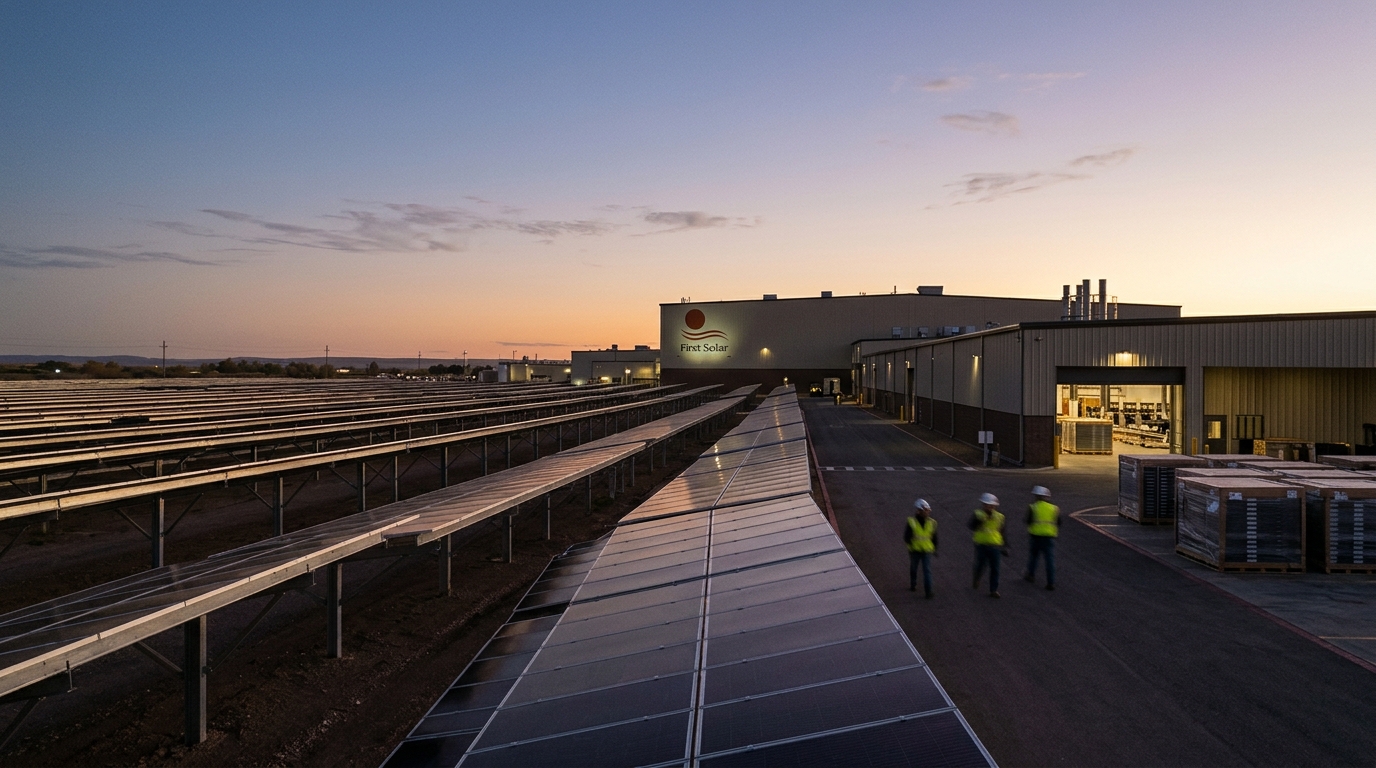
Every name in the TAN complex rallied, but First Solar’s gain rests on something the others lack: a balance sheet that does not need Washington to stay cooperative in order to function. As of its most recent filing, First Solar carried $1.7 billion in net cash and a contracted sales backlog of 45.1 GW extending through 2030. The company anticipated receiving $2.07 billion to $2.19 billion in Section 45X Advanced Manufacturing Production Tax Credits for full-year 2026, directly fueling profitability and funding expansion. That credit stream is now far less likely to face repeal, which is what the market priced today. Unlike competitors reliant on overseas supply chains, First Solar is the domestic manufacturing leader in thin-film technology, entering this post-election cycle with a multi-year booked backlog and pricing power insulated from foreign trade disputes.
At a trailing P/E of about 10.7x, First Solar was already trading at a valuation discount relative to its own recent history before today’s move. The 11% session closes some of that gap without erasing it. The stock is not cheap on a momentum buyer’s terms, but it is not priced for the volume recovery that Democratic control now makes plausible.
Where the Rally Is Running Ahead of the Fundamentals
Enphase and Sunrun are a different calculation. Both rallied hard; neither has resolved the structural problem that sent them down before the vote. Enphase sank about 20% on October 28, 2026 after issuing weak fourth-quarter guidance, pointing to revenue as low as $225 million. Enphase has cited the lack of a meaningful recovery in U.S. demand and tied the weakness to higher interest rates and the expiration of the Section 25D federal tax credit for residential solar. Democratic control does not restore that credit or cut mortgage rates overnight.
Sunrun’s situation is structurally similar and financially more exposed. Its business model requires substantial outside financing to grow, and it remains dependent on financing from outside parties. It is funded by non-recourse asset-level debt securitizations and tax equity partnerships, so higher capital costs flow straight into unit economics. Sunrun revised its full-year cash generation outlook down to $200 million to $375 million, citing reduced affiliate channel volumes, a delayed ramp in direct sales, and higher capital costs. A friendlier Senate does not refinance that debt stack.
Building Wealth Around This Move
The right way to position after a sentiment-driven day like this is to let the rally sort itself. First Solar is the name where policy tailwind and financial strength are pointing in the same direction. The company’s board also authorized a $500 million share repurchase program alongside its most recent quarterly results, a signal from management that cash can now serve shareholders rather than just fund construction.
Enphase and SolarEdge have longer-term optionality worth watching: both are developing solid-state transformer technology aimed at higher-power applications, including data center infrastructure. That is a 2028 conversation, not a November one.
Chasing Enphase or Sunrun at today’s close means buying sentiment recovery before operational recovery. The fundamentals are still pointing down. For investors building a clean-energy position with a multi-year horizon, First Solar earns its seat in the portfolio today. The rest of the complex earns another look only when the demand numbers, not the vote count, say so.