
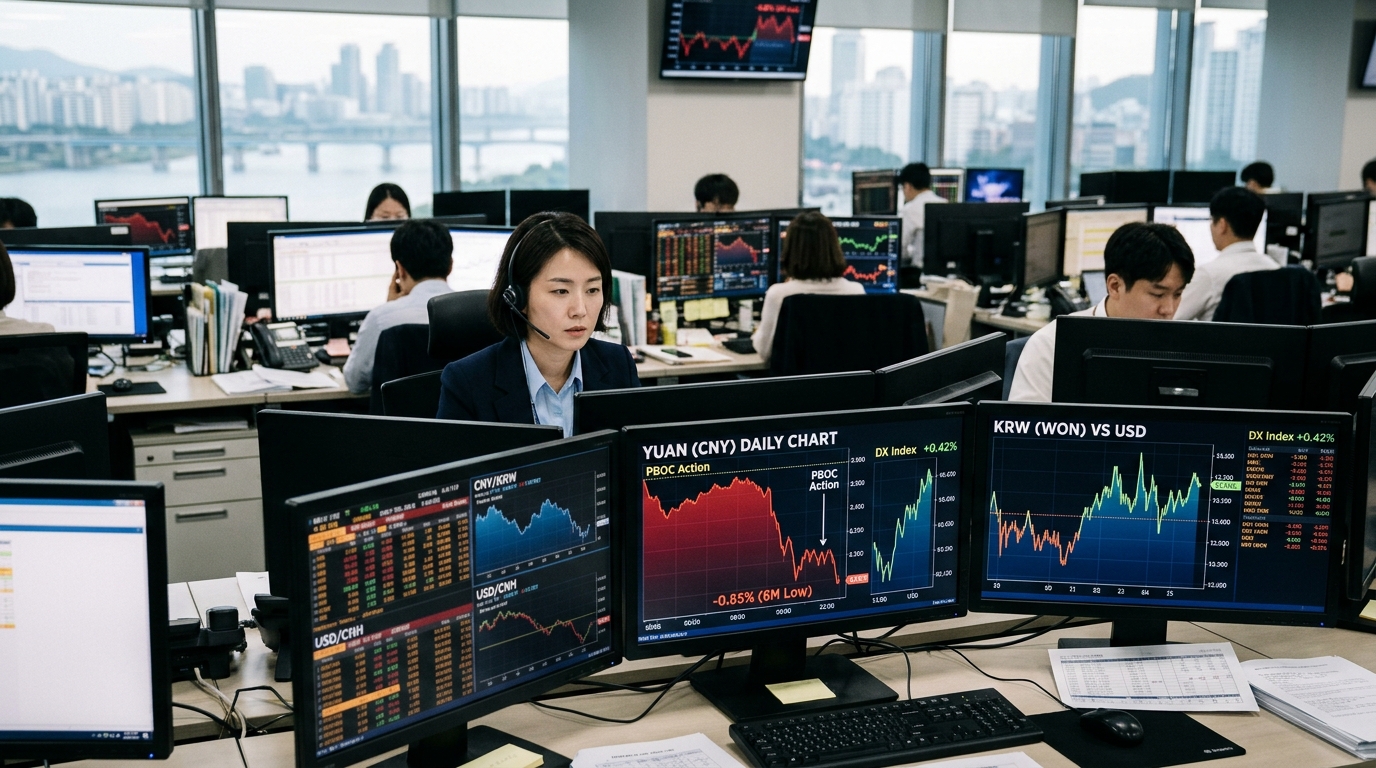
The People’s Bank of China did something unusual this morning: it acted to weaken its own currency. The move is worth paying attention to, not just in CNH, but across a cluster of Asian FX pairs and into the U.S. dollar index.
In a statement Tuesday, the PBoC said it would raise the foreign exchange deposit reserve requirement ratio by 2 percentage points to 6% from 4%, effective November 15. Reuters estimated the shift could withdraw about $24 billion from the system. The mechanism is deliberately indirect: the ratio sets how much of their foreign currency deposits banks must hold in reserve, and raising it reduces the dollars available onshore. By tightening that plumbing, Beijing can lean against appreciation without touching headline rates.
The offshore yuan fell about 0.3% to around 6.66 per dollar, pulling back from a more than four-year high hit in the previous session. That was the biggest one-day slide in the yuan since May 15, snapping a run of gains that had stretched for nearly three weeks.
The PBoC also reinforced the signal in its daily fixing. It set its midpoint for a second day in a row at 6.7150 per dollar, far weaker than market estimates, in what Reuters described as the largest weak-side deviation since September 10. Two tools pointing the same direction in the same morning is not ambiguity. It is policy.
The context matters. The yuan has gained more than 5% against the dollar so far this year, making it one of the best-performing Asian currencies, helped by strong exports, big trade surpluses, and heavy corporate FX conversion. Exporters typically convert more of their FX earnings into yuan toward year-end and ahead of the Lunar New Year, driven by accounting needs and seasonal demand for cash. Such an influx of FX conversions can add to yuan strength in December and January. The PBoC is getting ahead of that flow.
Barclays analysts, cited by the South China Morning Post, noted that the last time the PBoC adjusted the ratio was in September 2023, when it cut it from 6% to 4% amid depreciation pressure on the yuan, and the bank is now likely to continue smoothing appreciation rather than encouraging an unchecked rise. MUFG China’s chief financial market analyst Marco Sun put it plainly: by absorbing part of the available dollar liquidity in the banking system, it is attempting to reduce the momentum behind yuan appreciation and prevent the market from developing excessive one-way expectations.
Chinese equities did not find comfort in the move. Reuters reported Chinese stocks reversed course in early trading Tuesday as investors continued selling technology and energy shares, with the CSI 300 and Shanghai Composite both down more than 1% in early trade. Separately, Reuters has calculated that the STAR 50 tech index is down roughly 40% from its midyear peak. The FXI, the iShares China Large-Cap ETF, is down about 15.7% year to date and continues to reflect that equity weakness directly for offshore investors.
The more interesting signal for today is in Seoul. The KOSPI ended at 5,648.79, down 210.29 points or 3.59%, with foreign investors and institutions selling a net 1.52 trillion won and 511.3 billion won respectively. The won itself, at 1,341 per dollar at the 3:30 p.m. close, showed modest resilience relative to equities. But the dynamic to watch is the spillover: a cheaper yuan effectively exports competitive pressure on Korean exporters, particularly in electronics and semiconductors, where Samsung and SK hynix compete directly with Chinese producers.
The dollar index, sitting near 101.75 as of Monday’s close, is the other lever. A yuan that the PBoC is actively capping gives the dollar a floor in Asia, and any sustained CNH weakness tends to pull the broader EM FX complex with it, including the won.
What would make this read wrong: traders and analysts do not expect the move, by itself, to reverse the yuan’s upward trend. If seasonal corporate conversion flows overwhelm the liquidity drain before November 15, CNH could retrace today’s drop quickly. A softer-than-expected U.S. payrolls number later this week would also undercut dollar support and potentially nullify the PBoC’s intervention. Watch whether USD/CNH holds above 6.66 over the next three sessions. If it cannot, the signal fades. If it does, the won faces a more sustained headwind into year-end.