
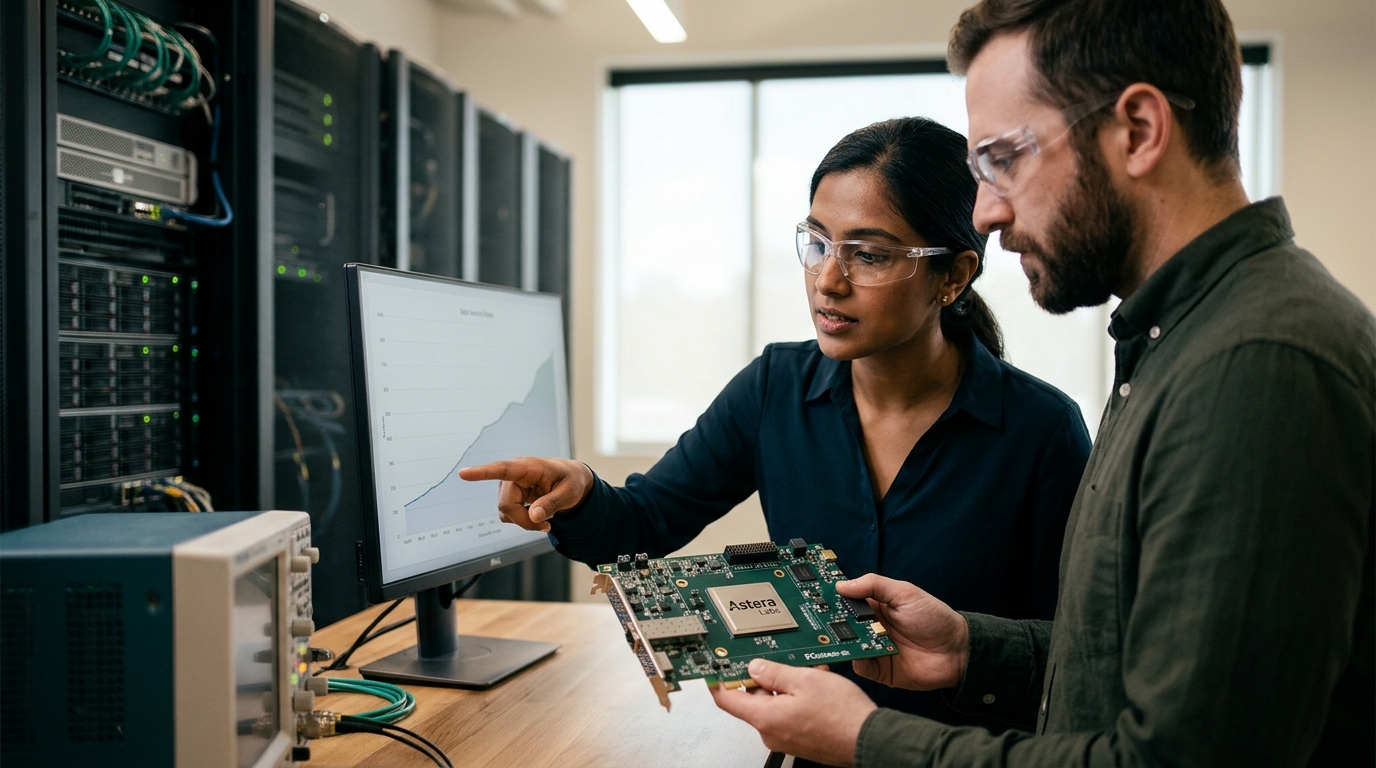
Astera Labs is not a household name, but the numbers it is about to post may make it one. The company reports Q3 2026 results Tuesday after the close, and the guidance it issued in August was aggressive enough to stop analysts mid-sentence. Management projected Q3 revenue of $540 million to $560 million, implying approximately 40% sequential growth from a Q2 that was already up 27% sequentially. Non-GAAP EPS guidance of $1.16 to $1.21 was more than 40% above the $0.81 analyst estimate at the time. That kind of gap between guidance and consensus does not happen by accident.
The Business
Astera Labs designs semiconductor-based connectivity solutions for rack-scale AI infrastructure. Its three product lines, Aries signal-conditioning retimers, Taurus Ethernet controllers, and Scorpio AI fabric switches, address the data movement problem that gets worse the larger an AI cluster becomes. Bigger GPU clusters require faster, lower-latency, higher-bandwidth connections between accelerators. Astera builds the silicon that makes those connections work without becoming a bottleneck. Q2 2026 revenue of $392.4 million was up 104% year over year, driven by broad-based growth across all three product families.
The Scorpio X-Series 320-lane fabric switch is the product carrying the most weight heading into Tuesday. Management said in August that Scorpio would become Astera’s largest product family in Q3, arriving a full quarter ahead of their original forecast. That is not a rounding error; it means the hyperscaler pull-through for fabric switches is running materially ahead of plan. New design wins across a broadening customer base, plus expansion into optical interconnects, extend the company’s runway well beyond what the current revenue base reflects.
Why the Beat Streak Matters
Astera has beaten the EPS consensus in each of the last four quarters, with an average surprise of about 17%. When a company consistently clears the bar by that margin, one of two things is true: either management guides conservatively by design, or demand is genuinely outrunning the models. In Astera’s case, both appear to apply. The Q3 EPS guidance midpoint of roughly $1.19 sits nearly 40% above where consensus sat before the August update, suggesting Wall Street has not fully absorbed the Scorpio ramp into its models.
What Could Go Wrong
The valuation is the primary risk. Astera has recently traded as high as roughly 148 times trailing earnings, a multiple that demands sustained outperformance. Any signal that the Scorpio ramp is slower than guided, or that gross margins are compressing more than the approximately 72% non-GAAP Q3 target implies, would hit the stock hard. Competition from Broadcom and Marvell in connectivity silicon is real, and hyperscalers have leverage over any supplier when they represent a concentrated share of demand. Customer concentration is a structural risk the company has not fully diversified away from.
That said, the specific question for Tuesday is narrow: did Scorpio ship at the volume and mix management projected? Four straight beats and a guidance raise that exceeded consensus by 40% say the answer is probably yes. Astera is one of the few companies in the AI infrastructure stack that is growing revenue at three-digit year-over-year rates while expanding margins. That combination is rare enough that Tuesday’s report deserves a close read, whatever the stock does immediately after.