
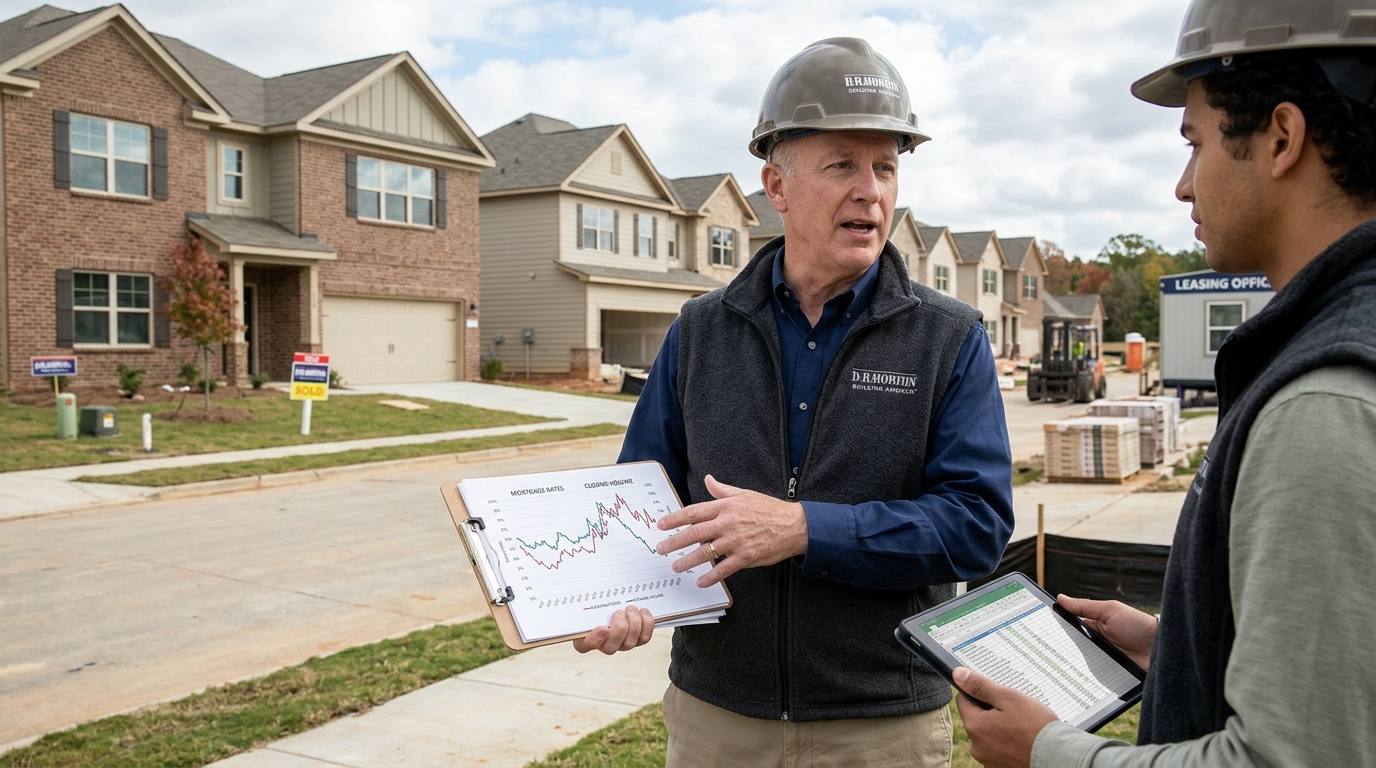
D.R. Horton (DHI) reported its fiscal fourth-quarter and full-year results this morning, capping a year defined less by how many homes it built than by how much it paid to sell them. The backdrop could not be more hostile. The National Association of Realtors reported that the pending home sales index fell 7.3% in September to 66.0, its lowest reading since the series began in 2001, and pending sales have since dropped further, sitting at a record low through the four weeks ending October 18. Mortgage rates have been holding around 7.4%, the highest level since 2023.
Against that, analysts expected DHI to post roughly $9.07 billion in Q4 revenue, down about 6% from $9.68 billion a year ago, with earnings per share essentially flat at $3.01. The full fiscal year was expected to show EPS of around $10.44, down nearly 10% from $11.57 in fiscal 2025. Those are the headline numbers, but they are not the story.
The story is what it costs to move a house when a 30-year mortgage runs 7.4%. Through the first nine months of fiscal 2026, D.R. Horton’s home sales gross margin had declined to 20.4% from 22.1% a year earlier, with management specifically citing higher sales incentives, including mortgage interest rate buydowns, as the culprit. Every buydown the company funds to push a buyer across the finish line appears in the cost-of-sales line, not in a marketing budget. The trade is straightforward: give up margin, protect volume.
Across the homebuilding sector, incentive levels have been running in the low double-digits as a percentage of sales price, well above more normal conditions. Lennar’s (LEN) most recently reported all-in incentive rate was about 12.9%, versus what it called normalized levels of 4% to 6%. PulteGroup (PHM) has also described incentive levels around the low double-digits in recent quarters. D.R. Horton guided Q4 home sales gross margin to a range of 20.5% to 21%. NVR, which is land-light and does not rely on spec inventory in the same way, saw its gross margin fall to 19.2% from 21.5% in the second quarter. There is no clean escape from 7%-plus rates regardless of strategy.
For readers deciding whether to buy a home, the incentive disclosures from today’s results carry practical weight. Builders are selling the monthly payment, not the sticker price. A rate buydown funded by D.R. Horton may get a buyer into a $350,000 home at an effective rate well below 7.4% for a period of years. That is real savings today, but it is worth understanding the buydown costs are baked into the home’s price or the builder’s margin, not charity. When rates eventually fall, a buydown that was the deciding factor at purchase disappears as a comparative advantage.
For readers who hold or are considering builder shares, the margin disclosure is the number to watch. DHI trades at roughly 14 times trailing earnings, which is not expensive in isolation. The risk is that incentive spending continues rising as rates hold, and the earnings that multiple is applied to keep shrinking. The company has already cut its fiscal 2026 revenue guidance once, to a range of $32.5 to $33.0 billion, as Reuters reported in July.
The wealth-building lesson from this earnings cycle is one builders already know: capital structure and cost structure matter most in a rate shock, not brand or market share. DHI has both balance sheet strength and national scale that smaller builders lack. Those advantages do not make the margin compression disappear, but they make it survivable. The question for investors is whether the housing market spends another year at 7%-plus, or whether rates pull back enough to let incentive loads normalize and margins recover. Today’s results give the most current available answer to how much longer the current pace is sustainable.