
The headline numbers look like a gift. September retail sales rose 0.8% month-over-month, well above the 0.3% forecast, following an upwardly revised 1.3% gain in August. The same morning, the National Retail Federation projected holiday sales growing 4.2% to $1.013 trillion, an acceleration from last year’s 3.1% gain to $972 billion. Investors celebrated. They should look closer first.
Gas stations drove the September headline, with spending there soaring 6.4% on higher prices. The retail sales figures are not adjusted for inflation. Strip fuel out and sales rose just 0.2% in September. Michael Pearce, chief U.S. economist at Oxford Economics, put it plainly: “The large jump in headline retail sales in September was almost entirely due to rising gasoline prices.” The NRF’s chief economist, Mark Mathews, said higher prices are expected to account for about half of the 4.2% forecast gain. The trillion-dollar milestone, in other words, is partly an inflation artifact.
A Season That Belongs to One Kind of Shopper
The more important question is who actually drives the real-volume half. Higher-income shoppers will drive much of the season’s spending, though most lower-income groups are now spending more than they did a year ago. That gap is where the investment thesis lives.
Retailers including Walmart, Kohl’s, and American Eagle have flagged pressure on consumer spending ahead of the critical holiday period. But not all retailers face the same exposure to that pressure. The consumer economy in 2026 is not contracting uniformly. It is bifurcating, and three retailers sit squarely on the right side of that divide.
Where the Money Goes
Amazon (AMZN) benefits most when higher-income households dominate the spending pool. Its Prime membership concentrates loyal, repeat spenders in the demographic doing the heavy lifting this season. Its retail media business compounds the advantage: even if shoppers spend cautiously, brands still pay to reach them through Amazon’s platform.
Walmart (WMT) tells a less obvious but equally compelling story. Walmart has said its share gains were led by upper-income households, meaning value retail can win even when wealthier households are not distressed. They may simply prefer price transparency, delivery, grocery frequency, and convenience.
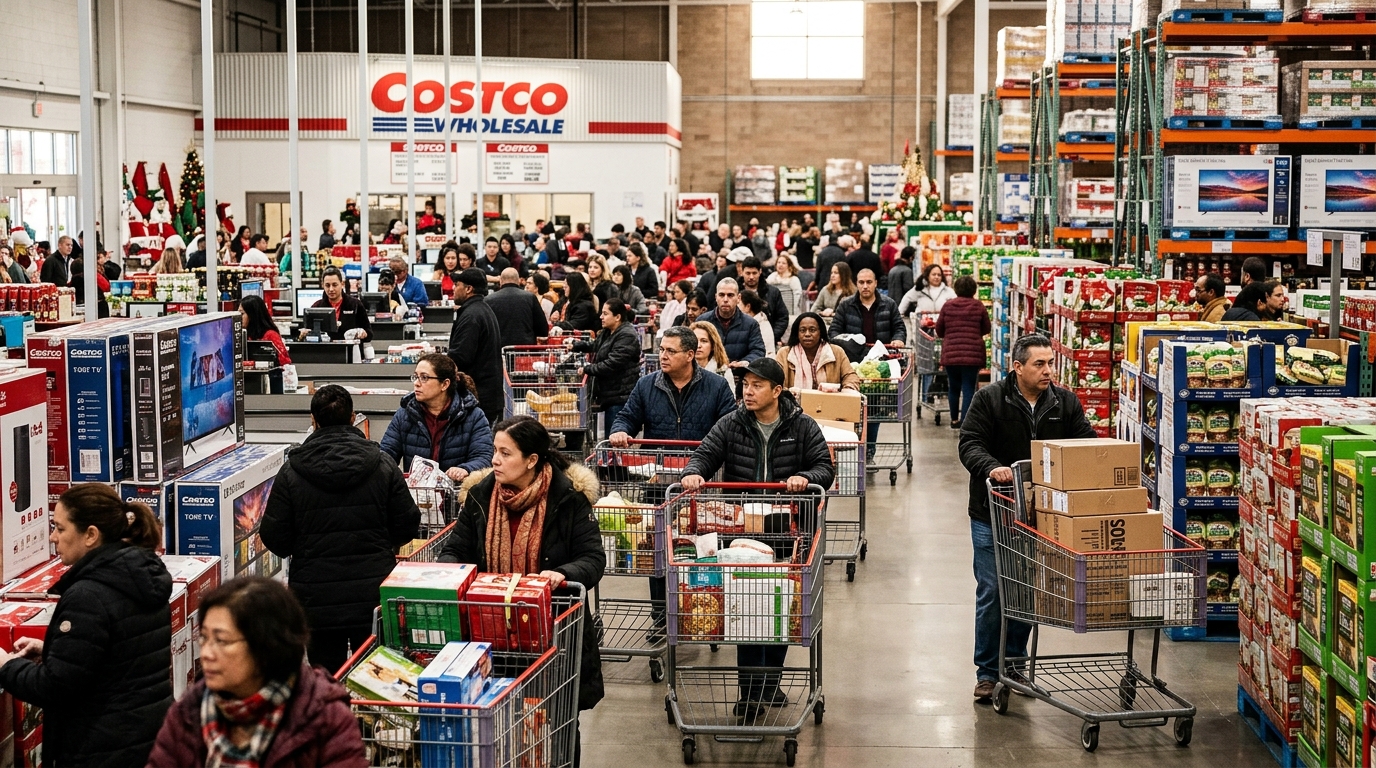
Costco (COST) runs the same playbook with a membership model that reinforces commitment. Net sales for Costco’s second quarter of fiscal 2026 reached $68.24 billion, up 9.1% from the prior year. Paying an annual fee creates a gravitational pull that keeps those shoppers returning.
Target (TGT) occupies harder ground. Target sources a significant portion of its general merchandise from overseas suppliers and is exposed to import cost inflation, with shipping, warehousing, and last-mile delivery costs all rising simultaneously. The categories most affected include clothing, home goods, and electronics, the discretionary purchases that Target shoppers rely on. Those are precisely the categories budget-conscious consumers are cutting first.
Building Around the Theme
For long-term investors, the structural argument runs beyond this holiday season. That makes quality of customer base more important than total store traffic. Retailers with outsized exposure to higher-income households are insulated in ways the aggregate retail sales data cannot show.
A position in Amazon or Costco acts as both a holiday trade and a longer-duration bet on where wallet share is migrating. Walmart adds grocery and essentials defensiveness. Together they cover the three structural advantages in a two-speed consumer economy: platform scale, membership loyalty, and value authority.
The $1 trillion headline will attract attention. What matters for investors is that most of the volume behind it flows through a small number of retailers built for exactly this environment.
Risks to Monitor
Fuel prices that drove September’s retail number higher remain a live risk. If energy costs stay elevated through November, they compress the real disposable income that higher-income shoppers use to fund discretionary gifts. A sharper-than-expected slowdown in the retail control group, which came in at just 0.1% in September against a 0.3% expectation, would be the first warning sign that even the resilient cohort is pulling back.
Daily Wealth Takeaway
Aggregate spending data tells you that consumers are spending. It does not tell you who is spending, where they are spending, or whether the dollar figures reflect real volume or simply higher prices. The investors who build wealth through retail exposure are the ones who ask those questions before the holiday headlines do the work for them.