The math looks obvious at first. Retrofitting an existing facility for liquid cooling runs around $2 million per megawatt, versus $11 million per megawatt or more for a new greenfield liquid-cooled build. That is an 80% headline discount, and in a capital environment where Amazon alone has said it expects roughly $200 billion of capex in 2026, the pressure to find cheaper paths to AI-ready capacity is intense. Retrofit looks like the answer. Often, it is not.
Why Air-Cooled Facilities Can’t Survive the Next GPU Generation
The density problem is unambiguous. Rack power densities are being pushed beyond the practical limits of air cooling, with a threshold effect around 40 kW per rack and AI roadmaps moving toward 200 kW or more.
Uptime Institute has warned that enterprise IT and AI infrastructure requirements are diverging, with many organizations likely to be cautious about adopting liquid cooling in production environments. That caution is exactly why retrofit is drawing capital instead of demolition orders.
What the Rack Price Doesn’t Capture
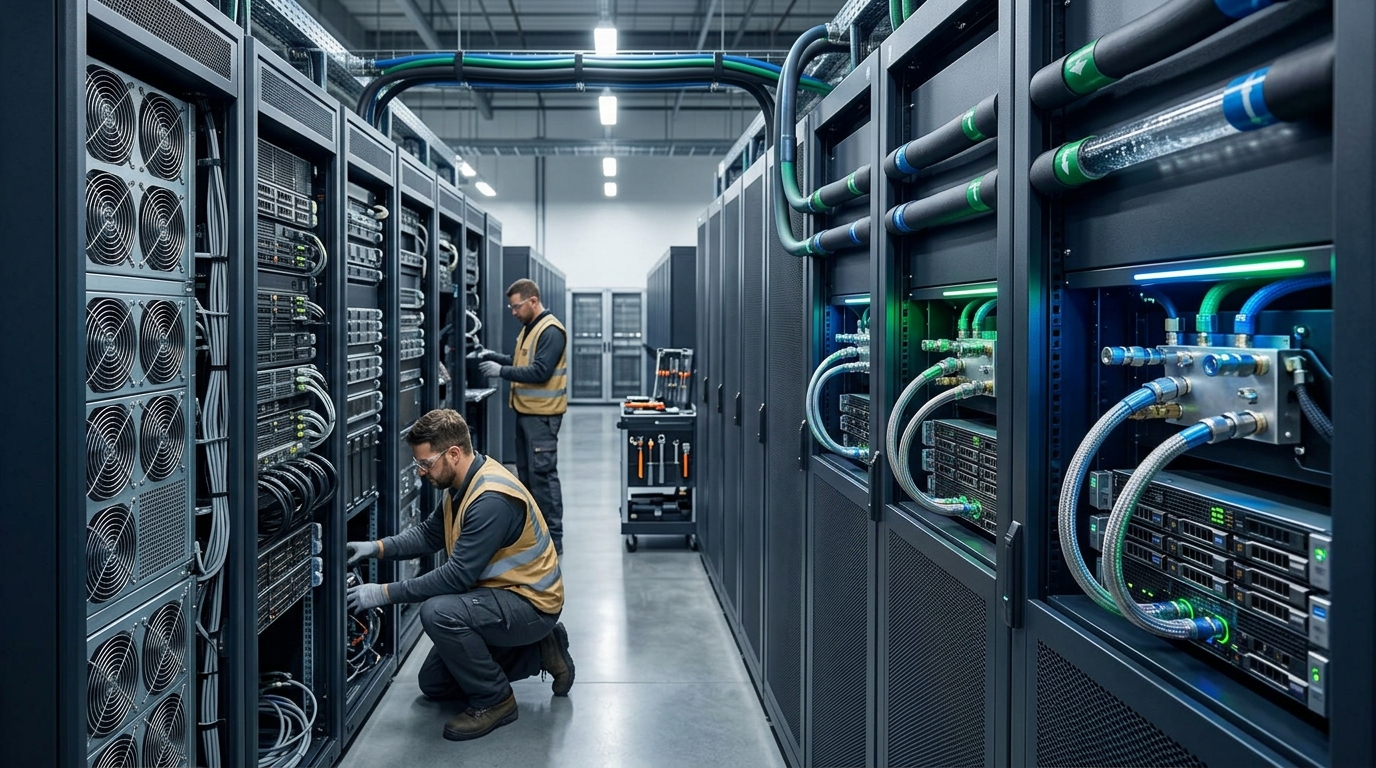
The per-rack figures depend heavily on which cooling architecture gets chosen. Rear-door heat exchangers run $8,000 to $15,000 per rack for 15 to 30 kW densities. In-row liquid-assisted systems cost $20,000 to $35,000 per rack for 40 to 100 kW zones. Direct-to-chip retrofits run $50,000 to $80,000 per rack for workloads above 60 kW.
None of those figures include what the building itself demands. Structural limitations prove harder to overcome than cooling or power constraints. Many legacy raised-floor environments were designed around roughly 150 pounds per square foot for distributed loading, while high-density AI deployments can require materially higher floor-loading capacity and, in some cases, structural work. A direct-to-chip project may look like a per-rack purchase, but the budget typically spreads across cooling distribution units, manifolds, hoses, quick disconnects, leak detection, controls, heat rejection, commissioning, and staff training.
A 20-rack deployment can land in the low single-digit millions once equipment, electrical work, installation labor, project management, and contingency are included. That translates to well over $100,000 per rack on a project where the cooling hardware itself might have been quoted at $50,000 to $80,000.
The Cost Hyperscalers Don’t Talk About
Liquid cooling retrofits in live facilities can stretch across many months, and the all-in cost per megawatt converted can move much closer to greenfield levels once operators price in power work, commissioning, live-site risk, and migration. That is a long way from the $2 million headline.
The full investment case looks very different once operators factor in customer workload migration, downtime, lost tenancy revenues, and the limitations of legacy infrastructure. Hyperscalers and AI scale-ups can move earlier because they can underwrite demand internally, while wholesale and retail colocation providers need stronger customer commitments, lease certainty, and migration plans before upgrading live facilities.
Where the ROI Actually Closes
ROI depends heavily on the density and utilization of the liquid-cooled racks. At 60 kW or above with sustained GPU utilization, payback periods can compress materially. A PUE improvement from 1.60 to 1.15 at a 100 MW hyperscale facility would reduce non-IT overhead from 60 MW to 15 MW, a 45 MW reduction. At an electricity price of about $0.09 per kWh, that is roughly $35 million per year in avoided electricity spend.
The trade is only attractive when the existing shell, power path, and grid position still hold value. Retrofit pressure is highest where strong AI demand coincides with power or permitting constraints. In those markets, secured power in existing facilities becomes too valuable to give up. Everywhere else, the $2 million figure is the beginning of a longer and messier conversation than the headline suggests.