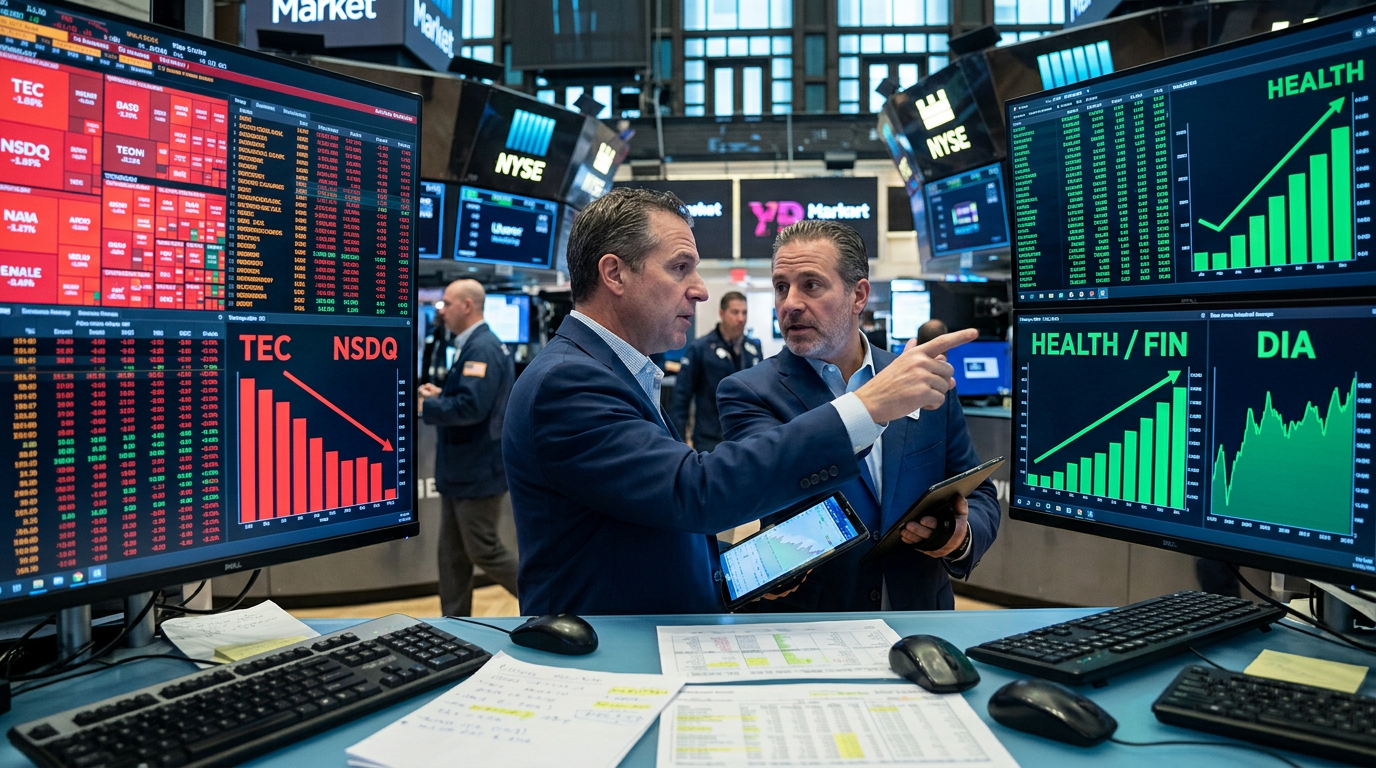
Thursday’s session was one of those days where the index headlines don’t tell the story. The Dow jumped 874.86 points — a 1.73% gain — closing at a fresh all-time high of 51,561.93. The Nasdaq, meanwhile, lost 0.09% and ended at 26,830.96. The S&P 500 split the difference at 7,584.31, up just 0.41%.
That kind of Dow-Nasdaq divergence doesn’t happen randomly.
What’s Actually Driving This
The rotation was sparked by Broadcom’s earnings reaction — shares collapsed 12.59% to $418.91 after reporting fiscal Q2 revenue of $22.19 billion, narrowly missing the $22.27 billion analyst consensus. The day prior, AVGO had traded at a new all-time high of $495. That kind of reversal from all-time-high to -12% in one session rattles the whole AI-adjacent trade and sends capital hunting for a new home.
It found one fast.
UnitedHealth Group led the Dow higher, surging more than 5% after Bank of America upgraded the stock to Buy and raised its price target. That single move had an outsized mechanical impact — the Dow is price-weighted, so a large move in a high-priced stock like UNH carries disproportionate index weight. Goldman Sachs rallied roughly 4.91%. JPMorgan Chase added 3.34%. American Express and Visa attracted steady institutional buying throughout the session.
Eli Lilly climbed 4.31% on the day — a massive absolute move on a stock trading near $1,125 per share. The broader healthcare sector gained more than 2%. This wasn’t just a one-stock story.
The Macro Backdrop
Initial jobless claims hit their highest level since early February, with first-time filings totaling 225,000 for the week ending May 30 — up 13,000 from the prior period and above the Dow Jones consensus estimate of 215,000. Productivity rose just 0.3% in Q1, below the 0.5% forecast. Unit labor costs increased 1.8%, below the 2.4% estimate.
Slight tangent, but it matters: the VIX recently printed a 15 handle. That’s down from over 30 on March 30, near the Iran-conflict volatility peak. A VIX at 15 isn’t complacency exactly — it’s a market that has repriced risk downward. The question is whether it’s done so accurately or prematurely.
The US market is up roughly 26–28% over the past year, with earnings projected to grow 17% annually. That’s a favorable backdrop. But macro unresolved risks — geopolitical tensions keeping oil prices elevated, sticky inflation around 3%, and labor market softening — haven’t disappeared. They’ve just been temporarily outweighed by AI CapEx momentum and corporate earnings strength.
Sector-by-Sector Breakdown
Healthcare: UNH’s Bank of America upgrade is the catalyst, but the move has broader implications. UnitedHealth trades at approximately 21 times full-year earnings estimates — a valuation that looks attractive relative to its historical range, especially if management’s guidance for earnings acceleration through 2027 holds. Analysts estimate 9–10% annualized growth over three to five years as premium hikes take effect. Eli Lilly, meanwhile, trades at 45 times forward earnings — rich, but analysts are calling for 37% annualized earnings growth over the same period, driven by the GLP-1 weight-loss drug market. Experts forecast that market growing from $15 billion to potentially $150 billion over the next decade. Lilly’s oral weight-loss medication, orforglipron, and next-generation injectable retatrutide are both in Phase 3 trials.
Financials: Goldman Sachs, JPMorgan, American Express, and Visa all participated in Thursday’s rally. These are businesses that don’t need the AI chip cycle to beat by a billion dollars — they need the economy to hold together. Right now, the data suggests it is. Costco added around 1%. Walmart gained nearly 1%. The consumer-adjacent names are holding.
Defense: RTX Corp gained 3.98% on the session. The Defiance Drone & Modern Warfare ETF (JEDI) added 4.79%. Defense spending themes remain structurally bid with geopolitical tensions ongoing.
Semiconductors: Mixed. NVIDIA managed a modest +1.97% — not a leadership day, more of a survivor. The broader chip complex underperformed as investors pared AI exposure following the Broadcom reaction.
The Key Question Going Into Friday
Nonfarm Payrolls. That’s the immediate binary. A soft number eases pressure on the Fed and supports rate-sensitive names — healthcare, financials, consumer. A strong number pushes the 10-Year Treasury yield higher, which creates problems across the board for anything priced on future cash flows.
Whether the rotation sticks long-term depends on what the next round of AI earnings delivers. If chip companies come back with blowout numbers, capital rotates right back into semiconductors and the Thursday move looks like a one-day distraction. If more quarters come in like Broadcom’s — technically fine, but not good enough relative to elevated expectations — the leadership change has room to hold.
Scenario Modeling
Bull Case: Friday payrolls come in soft-to-in-line, the Fed narrative stays dovish, and healthcare/financial names continue to attract institutional flows. The Dow extends its all-time-high run. UNH holds above the BofA upgrade level, LLY continues its GLP-1 momentum. S&P 500 targets the 7,700–7,800 range through June.
Base Case: The market consolidates near current levels. Tech stabilizes after the Broadcom-led flush, rotation continues but doesn’t accelerate, and the S&P grinds sideways in the 7,500–7,650 band ahead of the next major catalyst. Volatility stays contained near the 15–18 VIX range.
Bear Case: Payrolls surprise to the upside, rates spike, and the repricing hits both tech and rate-sensitive sectors simultaneously. The AI trade doesn’t recover fast enough to absorb the selling. The S&P breaks below 7,450 — a level that would change the near-term technical structure meaningfully. Watch the 10-Year yield — if it pushes back above 4.5%, the calculus shifts.
Active Trader Strategy Framework
The tactical setup right now is a two-sided positioning problem. The rotation out of AI-heavy names into healthcare and financials is real and data-supported — but the durability depends on macro data that hasn’t printed yet. Traders who chased the Thursday Dow rip into the close are already sitting on event risk. That’s fine if sized appropriately.
Key levels to monitor: UNH’s upgrade gap as near-term support. LLY’s $1,125 area — any fade toward $1,080 before the next catalyst is a level worth tracking. On the tech side, AVGO’s $418 close needs to hold; a break below $400 would confirm the post-earnings flush has more room.
The US market is at all-time highs in the Dow, near-record in the S&P. The earnings growth backdrop remains solid. But the rotation is telling you something about where incremental risk appetite is flowing — and right now, it’s away from anything priced for perfection in the AI trade and toward businesses that can compound without needing a chip supercycle to do it.
That’s a shift worth respecting, even if you’re not sure yet whether it lasts.
For informational and educational purposes only. Not investment advice. Trading involves risk, including loss of principal.